Tuesday, June 29, 2010

Summer days at Cherry Lake


White beardtongue on the prairie

This posting is an attempt to catch up and show some of what I've been doing and seeing out at our place at Cherry Lake in the Upper Indian Head Creek Valley. (This will be my last posting for a week or two. I am taking my daughter, Maia, on a tour of the prairie places I love best and some places I have never seen.)


These intrepid and happy (though moist) folks were with me on the 29th of May doing the first annual Cherry Lake Birdathon. We stayed mostly in the Indian Head Creek drainage, within 15 kms of Cherry Lake and managed on a very wet day to record 116 species, including two Mourning Warblers, a Connecticut Warbler, and a Sandhill Crane (one or two seem to hang around the Strawberry Lakes each summer). All told, we raised $2115 dollars for Bird Studies Canada, the lion's share going to the Last Mountain Bird Observatory banding station. Thanks to all who came out for the day and to those who donated to the cause.


The following Sunday we held "Bright Wings," a bird festival. 55 people came out for the day, taking workshops and tours to learn about the birds we share this watershed with. In this photo, the workshop and tour leaders are meeting for a short confab before getting started.

A photographer friend, Rocky Marchigiano led bird photography workshops with Ryan Peterson. Here are some photos he took during the festival, which he graciously allowed me to post.

A Black-crowned Night Heron. . .


And a Wilson's Phalarope. . .


And, another characteristic bird of the valley, American White Pelican.


There are always bright wings at Cherry Lake and not all of them are avian. Like most prairie farms, our place has a lilac hedge and when it blooms, as it was two weeks ago, the butterflies arrive. A pair of Monarch butterflies spent two days working the hedge blossoms.


Several Red Admirals joined in. . . .


As well as this Northwestern Frittilary. . . .


. . .and this ragged and torn Mourning Cloak.


A bumble bee (left) and a Yellow Warbler were in the hedge at the same time.


That evening, we went for a walk up on the grassland to look at the profusion of blooms on the prairie after the months of rain. Here are some of the flowers.

Great Plains Indian Paintbrush. . . .


Yellow Umbrellaplant. . . .


Indian Breadroot. . . .


Ground Plum (these are the seed pods). . . .


And the beautiful Plains Rough Fescue.


This guy was running through a patch of speargrass on a hilltop: the Smooth Green Snake, a species that reaches its limits in this part of Saskatchewan and is not that common, though we find it regularly each summer at Cherry Lake.

Tuesday, June 22, 2010

Breeding Bird Survey where there once was grass


Breeding Bird Survey point on cropland near Francis, Saskatchewan

On the weekend Karen and I did the Tyvan Breeding Bird Survey (BBS) and later this week, if the weather holds, my son Jon and I will head to Crooked Lake to do another one.

On Saturday morning there was no wind or rain to interfere with the chorus of birds along the 25 mile route across cropland in the Upper Wascana Creek drainage. The BBS, said to be the most important citizen science effort on the continent, has been going since 1966. The effort depends almost entirely on the ear-birding skills of amateurs, who are dispatched to pre-determined routes in breeding season to record the presence of birds by stopping to listen for three minutes at 50 stops a half-mile apart.

With all the rain this year there were wetlands everywhere on the first part of the Tyvan route. Ducks and other wetland birds were in good numbers and I was especially happy to hear so many American Bitterns, a bird that the BBS shows is declining over much of its range. I haven't tallied the results yet but I think I heard somewhere between 8 and 11 bitterns in the first 14 stops. Trouble is, the bittern's slough-pump, "ha-runk-a-dunk" call can be heard at least a mile away if things are quiet. So I was never quite sure if I was hearing the same individual at two consecutive survey stops.


American Bittern image courtesy of Wikimedia Commons

The Tyvan--Francis area ranges from gently rolling moraine to level glacial lake bed. I would estimate that more than 90% of the land is cultivated and so there is not a lot of grassland on the route but plenty of erstwhile grassland now growing grain, canola, lentils, and peas. The most common grassland birds are horned larks. . .


image courtesy of Val Thomas

Savannah Sparrows. . .


Vesper Sparrows. . .


Bobolinks. . .


Western Meadowlarks. . .


and Upland Sandpipers.


Some of the upland sandpipers seemed to be singing and flying over cultivated fields and horned larks were in cropland with short vegetation. Savannah and Vesper Sparrows were at almost every stop as long as there were open landscapes of some kind. The meadowlarks were in places where there is either hay land, native pasture (only three or four of the fifty stops), or cropland with grassy margins. I found bobolinks only at two or three stops where the grass was high enough, usually near a wetland.

At the end of the route, for the last ten stops or so, I am in a landscape that looks like a wasteland--nothing but crop running off to all horizons and almost no grass at the edges. Here is a typical view of these level, empty fields.


The emptiness is all the more pronounced by the paucity of birds. At each of these last stops, I typically count nothing but a couple of Savannah Sparrows and Horned Larks, with perhaps a passing gull or Brown-headed Cowbird.

Wednesday, June 16, 2010

Keep an eye out for Burrowing Owls


In your travels on the Saskatchewan prairie this summer you may come across a burrowing owl. If you do and the landowner has not already reported it to Operation Burrowing Owl (OBO), please be sure to call in to the HOOT line (1-800-667-HOOT (4668))and let them know where you saw it.

Here are two images that show the difference between a Burrowing Owl and the more common Short-eared Owl that will also be seen perching on fence posts or on the ground.

Here is a burrowing owl (note long legs, barring on breast)

(image courtesy of Alan MacKeigan)

and here is a Short-eared Owl (note distinctive face pattern and streaking rather than barring on breast; legs short)


If you are a landowner or know a landowner with owls who is not currently participating in OBO programs, please at least have a look at the Nature Sask web page on OBO to see what the program entails.

People can be reluctant to report endangered species on their property for fear that the government will somehow take control over how they use the land, but any farmer or rancher registered in OBO will assure you that nothing like that happens.

We are down to a few hundred pairs of these wonderful creatures in Saskatchewan and despite some recent signes of hope they are believed to still be in long term decline.

I was in Kamloops, British Columbia last weekend where I spoke to conservationists about grassland and grassland birds at the 10th anniversary of the Grasslands Conservation Council of B.C. British Columbia gave up its last wild burrowing owls a few years back, but they have instituted a re-introduction program that is now getting some good results. My host Bob Moody, Executive Director of the Grassland Conservation Council took me out to see a local pasture where conservationists have built artificial burrows and placed captive-bred owls. Some of these birds have migrated back to their nesting grounds on their own so there is a lot of hope that the program will over time develop some viable colonies of burrowing owls.

I met some of the folks involved in this work. They belong to the Burrowing Owl Conservation Society of B.C., another amazing British Columbia group full of energetic people making somer real progress on behalf of grassland ecosystems. Take a look at their website, for my money one of the best I have seen by an ENGO in a while.

I am going to close this posting with a series of images from their web site:


owls just outside the burrow


a field crew making burrows


young captive-bred owls ready for release


installing a new artificial burrow


captive-bred owl just outside one of the artificial burrows

Thursday, June 10, 2010

Grasslands in B.C.


image by Chris Hamilton, from the GCCBC web site

Grassland advocacy can be a lonely, discouraging path to follow. With grassland ecology and species in rapid retreat and threats from human activity multiplying (we can now add wind farms to the mix--if the proposed "Wild Rose" wind farms in southeastern Alta go ahead, the last Greater Sage-grouse of that province will vanish), you find yourself always scanning the horizon for any signs of hope, anyone doing something that might help. One group that came up on my horizon this winter was the Grassland Conservation Council of British Columbia (GCCBC).

Grassland in B.C.? I know, British Columbia is mountains, forests, and seashore. But they have grassland too. As the council points out on their website, “BC’s grasslands represent less than one percent of the provincial land base and are one of Canada’s most endangered ecosystems.”

Most states and provinces have at least some grassland, and the interesting thing is that the ones with very little, places like B.C. and Ontario and some eastern states, seem to have the best conservation and (especially) restoration programs in place. They have looked at their endangered species lists and seen that a good many of the species at risk depend on grassland (from the GCCBC website again: “More than 30 percent of British Columbia’s threatened or endangered species depend on grasslands for their survival.”)

This Saturday I have the privilege of addressing the B.C. council at its tenth anniversary celebration. I was happy to be invited to come to this great event but I have my own agenda too: I hope to learn something about what it takes to get such an organization started, because this province desperately needs a group dedicated to conserving and restoring grassland ecosystems. During the recent struggle to stop the provincial government from selling off our crown wildlife lands, it became abundantly clear that we do not have such a voice for grassland in Saskatchewan.

Thursday, May 27, 2010

71,000 coyotes killed--what does this mean for birds?


Here is today's news report on the final tally of from the coyote slaughter:

"Coyote ugly: 71,000 killed in Sask cull

By The Canadian Press
REGINA - A coyote bounty Saskatchewan offered hunters and farmers has resulted in more than 71,000 of the animals being killed.

Agriculture Minister Bob Bjornerud says the number is a surprise, but he's pleased with the results.

Bjornerud says the intention was not to eliminate coyotes, but to control the population because the animals were killing livestock and putting farm families in danger.

Jack Hextall, chairman of the Saskatchewan Cattlemen's Association, says attacks on livestock were costing producers thousands of dollars in losses.

The province paid $20 per coyote under a pilot program which ran from November until the end of March.

Bjornerud says the final cost for the program should be about $1.5 million."


Leaving aside the financial and political stupidity of a government spending $1.5 million to solve a problem that was "costing producers thousands of dollars," I am going to speculate on what losing 71,000 coyotes might do in the short term to grassland ecosystems that are already under a lot of stress from habitat destruction and conversion.

71,000 is a big number when we are talking about a top predator. In a post on January 15, I wrote about the effect of removing a lot of coyotes--particularly how it releases the Red Fox, a non-native predator, from any limits on its numbers. Though the fox is native to the continent it was not found on grasslands before settlement and agriculture. In the last century the Red Fox has had some periods where it has exploded in numbers, usually after a large loss of coyotes, which otherwise keep it in check.
(See Finley J.K. 2006. The rise and fall of the Red Fox beneath the apex of Palliser’s Triangle. Blue Jay 64(3): 155 - 159 and Finley, J.K. 2005. The fox that stole the apex of Palliser’s Triangle: a correction. Blue Jay 63(3) : 135-138)

Grassland birds are not adapted to predators such as the Red Fox and Racoon so when these mammals increase bird populations suffer.

Here is an excerpt from a research paper about a declining grassland bird, the Greater Prairie Chicken, explaining how nest success in ground-nesting birds (ducks and the prairie chicken) is greater in areas with higher coyote populations. And wherever coyotes numbers are down and Red Fox numbers up, nest success is cut in half. The full paper is available on the National Prairie Wildlife Research Center's website

"Red foxes and skunks have been the most common mammalian predators of prairie-chicken nests throughout most of the eastern range. Foxes generally have more impact than skunks because they commonly prey on the nesting hen. Over a 10-yr period, Svedarsky (1988) found December fox fur prices to be positively correlated with spring booming-ground counts two springs later. The conclusion was that trapping effort increased with the market incentive and that other potential predators were trapped as well (skunks, feral cats [Felis domesticus]). If trapping (and hunting) did, in fact, reduce mammalian predator numbers, it should have resulted in higher prairie-chicken production the next year and higher booming-ground counts the following year. This appeared to be the case. Further evidence for the high impact of foxes on large ground-nesting birds is that in areas where coyotes tend to displace foxes, nest success often increases. In North Dakota and South Dakota, Sovada et al. (1995) studied comparable areas except that some areas were dominated by red foxes and others by coyotes. Duck nests in coyote-dominated areas experienced nearly twice (32%) the nesting success as those in fox-dominated areas (17%). The authors suggested that managing an area for coyotes rather than for foxes could be an effective method of increasing duck nest success. Svedarsky (1992) observed an increase in apparent nest success of larger ground-nesting birds (ducks and grouse) over a 2-yr period in Minnesota. As coyotes apparently displaced foxes, nest success increased from 8.3% of 12 nests to 61.3% of 31 nests."

The voices of coyotes are part of the twilight and morning song of the prairie--something we take for granted like the creek running in spring. Last weekend my wife Karen and I were remarking that we have heard very few coyotes calling this spring. Most nights now there are none to be heard. To be honest, at first I wasn't thinking it was the coyote slaughter. After all, the estimate was merely 21,000 or so--more or less the same as an average winter. 71,000 is a very different number, different enough to do some short term damage that contributes to the long term decline of prairie ecosystems.

Two weeks ago, I saw my first red fox on the land since we purchased it in 2005. It was in broad daylight. The next weekend I saw two foxes in the same spot, again running in the light of day.

Meanwhile, the surviving coyotes are nursing their litters right now. If you care for the wellbeing of this land, lift a prayer or thought in their direction, that they may prosper this summer and replace that lost 71,000 as soon as possible.

Tuesday, May 18, 2010

Spring Birds of Indian Head Creek II


On the weekend I had a chance to get out to the pipit fields on and around Strawberry Lake Community Pasture. Two good friends, John and Michelle, came with me to see what grassland birds had arrived for the summer.

After the surprise of finding a pair of Say's Phoebe at an old farmstead (too distant to photograph), we stopped at one of the wetlands that head toward the beginnings of one arm of Indian Head Creek south of Lake Marguerrite. This Wilson's Snipe stood on his fencepost at roadside amid last summer's cattails . . .


Below him a male Northern Pintail stayed just long enough for this shot (click on any image to see a larger version).


As we neared the native grasslands of the area, I started to hear our first grassland sparrows singing, including this Vesper Sparrow . . .


. . .and the Savannah Sparrow featured at the top of this posting.

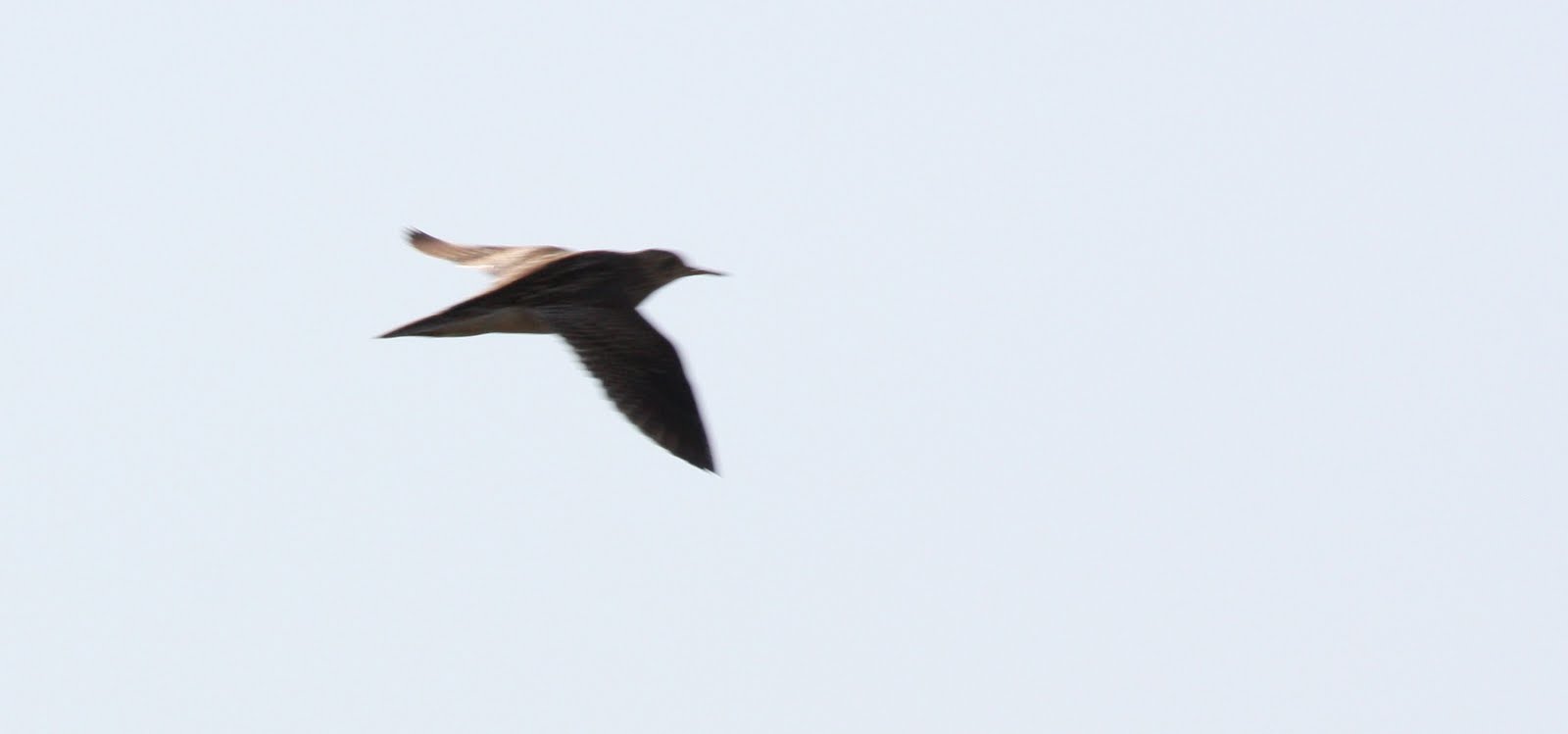
No Baird's Sparrows yet, but off in the pasture we heard an Upland Sandpiper giving its bubbling wolf whistle. We heard another, then saw two of them flying back and forth across the road. Unfortunately, this was the only photo I could manage.


Turning the corner west at an old cemetery and heading west along a tame hay field, I heard my first Sprague's Pipit of the year. We jumped out of the vehicle and leaned back on it to look up at the sky. We could hear its swishing, sibilant song perfectly, but we stared up into the blue for ten minutes or more and never managed a glimpse. Pipits are hard to see because they stay a couple hundred feet up in the air and sing, but I can almost always find the little bird-dot moving across the sky if I work at it. We moved on down the road and found another pipit and another, eventually counting five of them in that field, but try as we may, we could not find any of them. I wanted to show John and Michelle what they look like when they sing, but we eventually had to give up and move on.

The other grassland birds we saw on and around the pasture were Western Meadowlarks, Horned Larks, and Sharp-tailed Grouse (including a late lek containing at least 8 birds).

On the way back, we passed a set of ponds and sloughs in the community pasture and found a good mix of ducks and waders, including this female Wilson's Phalarope. . .


. . .and an American Avocet.


Back at our place at Cherry Lake, I tried sneaking up on a Lark Sparrow that had arrived to forage in the yardsite where we see them every spring. No dice, but I took a distant shot anyway, close enough to see the striking pattern on the sparrow's face.

Tuesday, May 11, 2010

Spring Birds of Indian Head Creek


Ring-necked duck

Got up early on Sunday morning at the cabin to see what birds had arrived. It was too windy to go out onto the uplands to look for grassland birds, so I trekked up the valley where I knew I could find a few birds in Aspen woods and beaver ponds.

The recent rain and snow has added a bit of gurgle to Indian Head Creek’s customary trickle so the ponds and lakes that feed this branch of the creek are all brimming.

The first swallow species back in spring, the Tree Swallow, is hardy enough to make the gamble that usually pays off in allowing them to secure good nest sites before other cavity nesters arrive. The risk they take is the weather we’ve been seeing for almost three weeks now: lower than average temperatures and late snowstorms, which make it hard to find insects.

I found this bunch clinging to the branches of a dead poplar overlooking Cherry Lake, waiting for the sun to stir a few bugs to life.


They had little desire to move so I walked in for a closer look.


I followed a small set of moose tracks up the trail to the second pond upstream of the lake. On the near shore, there were fresh scent piles, where a new pair of beavers is staking its claim on the pond. The dam is holding back enough water to attract buffleheads, mallards, and these guys, Ring-necked Ducks, which are the characteristic duck of the valley, and of the Aspen Parkland in general.


Like all diving ducks, they cannot launch straight into the air but run along the water for takeoff.


Farther on up the valley, I looked in vain for the resident pair of pileated woodpeckers, but I flushed a young bald eagle,


which then landed in the woods at the end of a set of terraced beaver ponds.


I heard and saw brief glimpses of a few birds that would not sit still enough for me to photograph, including three Spotted Towhees, two Bellted Kingfishers, some Yellow-rumped Warblers and a couple of Yellow-bellied Sapsuckers (that bird name always makes me think of Miss Hathaway in her birding get-up on The Beverley Hillbillies).

I did manage to get shots of a Vesper Sparrow,


Later that day, near the cabin, my daughter Maia (11) photographed a Lincoln’s sparrow too:

Share this post

Get widget