Sunday, January 15, 2012

Fallen Giants: Haig-Brown Legacy


a circle of firs growing on the Haig-Brown property

This morning on Michael Enright's Sunday Morning (which is one of the best things on CBC radio), he hosted a discussion on Leo Tolstoy. His two guests, academics who have studied Tolstoy's life and writing, spoke about his family land, Yasnaya Poliana, where he lived most of his life and wrote his great books. They made the point that Tolstoy's writing and life were greatly enriched by dwelling where his family had lived for generations, and that today we have trouble understanding the influence of such a relationship.

Here, where conservationist and writer Roderick Haig-Brown lived and wrote his 25 books during the mid-twentieth century, the larger community of Vancouver Island people, as well as fly fishermen, and environmentalists from all over the continent, have come to see the property as a spiritual home.

Lesley, a naturalist friend who knew Ann Haig-Brown and lives north of the river, told me today that when she lived in the house for a year she would often run into American fishermen while she was walking along the river trails. "I'd see them casting into the Line Fence Pool. They'd come all this way just to have the experience of fishing in this little pool in the river because it was in all of his [Haig-Brown's] books."


The Line Fence Pool

This town has had a couple generations of passionate defenders of salmon and the Campbell River all following Haig-Brown's example. Every creek has its committee of volunteers and there are brass plaques everywhere along the river in honour of people who gave their time and resources to protect and restore salmon habitat.

Here is one on the bridge at the outlet of Kingfisher Creek, which itself runs through the Haig-Brown property and was restored by volunteers in the decade after Roderick died.


During a walk on the property today, Lesley showed me where the great tree Haig-Brown called "the Big Fir" blew down many years ago. It was a Douglas Fir, which people here tell me is not a true fir, not that I would know a true one from a false one. In the late 1940s. Haig-Brown wrote lovingly of the great tree in the August chapter of Measure of the Year:

The Big Fir is slowly dying. It is dying because it is old, because it has a disease woodsmen call conk, and probably another disease called stump rot.


Then he talks about it being spared by the first generations of woodsmen, about people advising him to cut it down, and why he does not listen to their logic.

My guess is the tree has another fifty years of dying ahead of it, or somewhat more than I have. So long as any part of it is green I want it to stand.

The Big Fir was a good-sized tree before Hamlet was written and has managed to hold not only identity but life far longer than Hamlet's author held either. More human identities have been lost in every year of the tree's life than the tree itself has shed seeds. . . .If it were young and vigorous, I think I should not een resent its permanence. It is only just mortal, it is also only just living. But its enormous substance, lasting so long, yielding so little, seems to emphasize how short a time there is to look at things, to feel and know and think things.


But it did fall before Haig-Brown did. A winter storm took it down years before a heart attack laid Roderick on the earth not far away.

Here are two images showing all of the life growing from the nurse log formed by the Big Fir. In its death it is nourishing dozens of trees and shrubs all along its 130 plus feet. Large maples now reach for the sun, their roots feeding on the nutrients being released from the old fir.


How many writers and defenders of this good earth have been and will continue to be nourished by Haig-Brown's life on this land, his own time of standing tall here with "enormous substance. . .yielding so little," feeling, knowing, and thinking things?

Thursday, January 5, 2012

Birds of Christmas: Haig-Brown House, Campbell River


Hooded Merganser on a side channel of the Campbell River

On the 2nd of January my wife Karen and daughter Maia and I had a chance to join some new birding friends here in Campbell River to take part in the Christmas Bird Count for the city and surrounding area. Kim, Lesley, and Vicki are responsible for counting birds in the area north of the river's estuary and then the side of the river from the Haig-Brown House on Campbell River Rd up to the dam.

We were lucky with the weather. It was a bit windy, but warm and no rain. During the day I got my best looks ever at Golden-crowned Sparrows coming to the feeder of a friendly old gentleman who enjoyed our stopping by and especially the hug from Kim.

We ended the day with a race against darkness to see if we could locate at least one American Dipper on the upper river. We looked at all the usual spots near the dam and the bridge and were heading back to the car when Kim spotted on sitting on a metal platform at the base of a stairway. I took this photo of a dipper singing in the same general area a few days earlier.


Other highlights included great flocks of siskins buzzing overhead in the hundreds, and good looks at hooded mergansers.

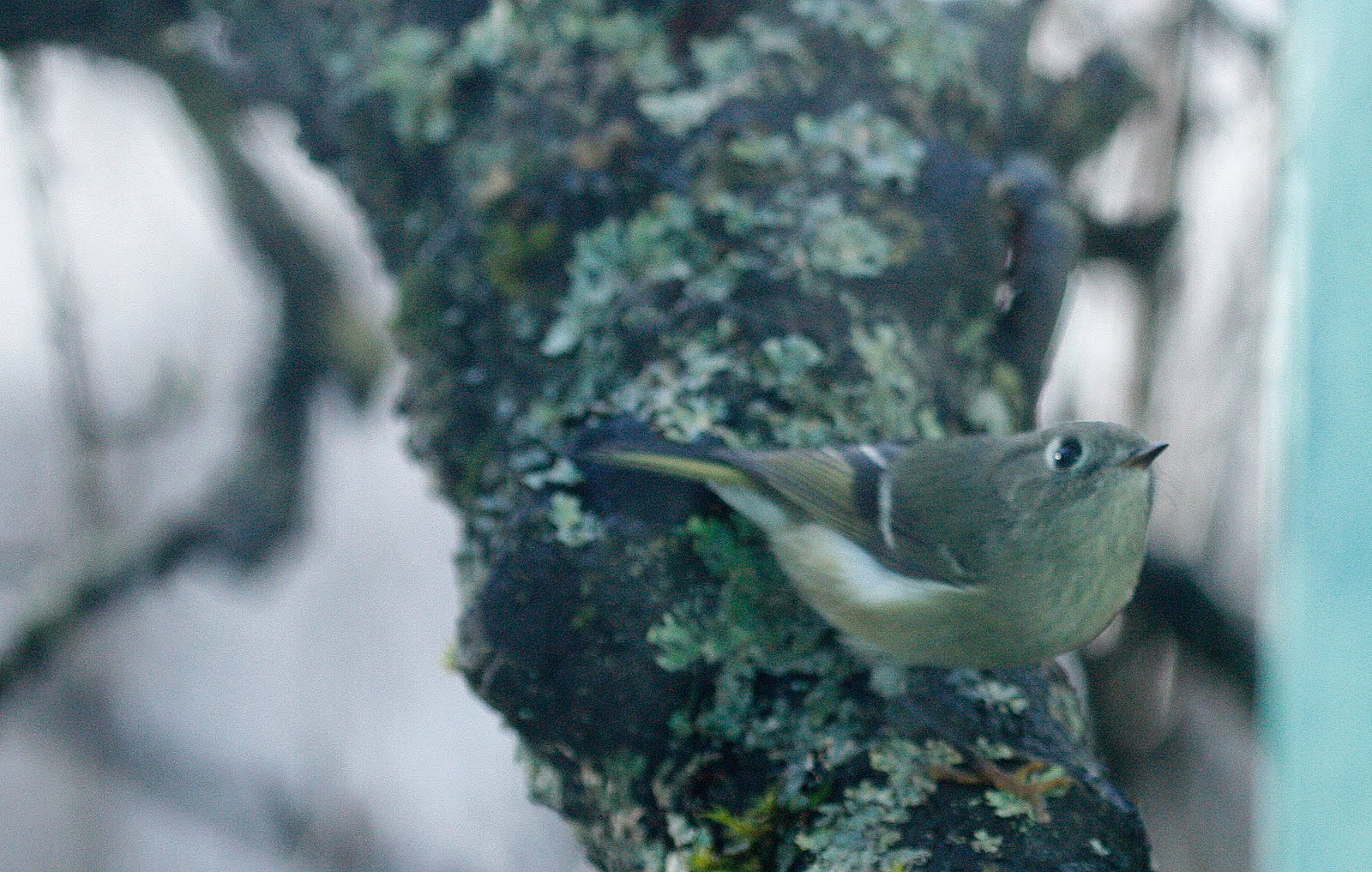
But for me the highlight was here on the Haig-Brown property when we found a bird who, to me embodies the contemplative, insular spirit of this place. We were making our way through the brambles on the eastern side of the property, and looking at kinglets. We had just counted 20 Golden-crowned and a single Ruby-crowned flitting through the mid to upper storey of the woods, when I came across a lone bird that looked much like another Ruby-crowned, except that it was moving very slowly and sitting still for a few seconds at a time. The broken eye ring looked different and it did not have the dark patch below the bottom wing bar that Ruby-crowned Kinglets show. But the thicker, vireo bill was the main feature that cinched the ID--a Hutton's Vireo.

This odd little bird has caused some confusion because after being vocal and easy to find all spring and summer it goes all quiet and solitary in winter, leading naturalists to assume originally that it was migratory.

Here is a note from an account of the vireo in an online atlas of B.C. fauna:
This species is generally more common than records suggest due to its quiet and retiring nature throughout much of the year, especially during the winter and in mid-summer when it is particularly difficult to detect.


Once people learned its call notes and how to separate it from the kinglet hordes, the Hutton's Vireo was established as one of the more interesting resident species of Vancouver Island.

In fact, the island has its own sub-species, vireo huttoni insularis. It is one of only four endemic birds on the island.

Kim, Lesley, and I stood transfixed as this quiet little greenlet foraged through the blackberry and rose brambles a few feet away. He was in no hurry to move on and in that moment seemed to me a wise forest hermit and I wanted to ask him what he knew of this place, this mid-winter of rain-drenched leaf and mossy branch.

I didn't have the camera with me, but made this drawing when I got back at the end of the day.


It was a fun Christmas Bird Count, and we recorded 48 species in our area alone, as well as this Red-throated Loon just outside our area.

Sunday, December 18, 2011

Photo Album: Winter Birds at Campbell River


A pool in Kingfisher Creek on the Haig-Brown property in Campbell River

I have had some great luck with weather since arriving here in Campbell River to work on this new book. I take an hour or two each Sunday to walk the beach and look for birds, and the last three Sundays have been warm and sunny. Here are a few of the birds I've been able to photograph (there were lots more I couldn't get a shot of:

This flock of mostly male Surf Scoters was near the shore at dusk where the Oyster River runs into the sea.


Lots of cormorants here--I have seen Double-Crested and Pelagic. This Double-crested looked like he was surfing on a piece of flotsam just below the surface.


Harlequin ducks are easy to find in the bays right in town.


I've seen all three merganser species here, but Commons are most abundant of the three:


I had some fun following a couple of Black Oystercatchers around a rocky beach along the sea walk in Campbell River.


These little Northwestern Crows here are real characters--always on the waterfront looking for a meal. It is actually a separate species from the American Crow.


One of the best parts about being here in the Pacific Northwest is to see all of the Great Blue Herons--they seem to still be in good numbers in this part of the world. This one was near the outlet of the Oyster River at the end of the day.

Saturday, December 10, 2011

The Haig-Brown Legacy


A portrait of Ann Haig-Brown, hanging on the walls of the Haig-Brown House

There are many genial spirits in this house, but the one I feel most clearly is Ann. I do most of my writing in her kitchen, watching the birds come to the branches by the window as they would have for her.

I was told that Ann was with Roderick when he died. He was in the yard working. Ann called him in for dinner. He turned and collapsed from a heart attack.


steam rising from the cedar fence on a cool morning on the Haig-Brown property

The Haig-Browns were both known for their compassion for people in trouble. Ann would open their home to battered women using it as an informal transition house. Today, the transition house in Campbell River is named after her.

Roderick, meanwhile, took his job as a country magistrate very seriously. He was thought of as being perhaps too lenient by some people--going easy on a teen caught with a small amount of marijuana--but he would always look at the whole context around the infraction that came before him, see the person and their life before making a decision.

Sometimes young men brought before his bench received sentences that included coming to the Haig-Brown farm once a week to learn about fly-fishing in exchange for some farm work. There were days when, between Ann and Roderick's social reform efforts, the perpetrator and the victim of the same crime would be on the property, a man out in a field with Roderick and the woman in the garden with Ann.

Roderick told one man who appeared in his court that if he stopped drinking and changed his ways he could live in the cabin on their property as long as he liked. He took up the offer and was living there when Roderick died and in fact remained in the cabin three or four years after Ann's death in 1994. The cabin was torn down just last year.


There are stories too of their bond as a couple. Roderick appreciated Ann's intelligence and would always consult with her on things that arose in his life as a writer, a conservationist, and a magistrate.

One story comes from someone who accompanied Ann to the airport to pick up Roderick after one of his many trips away from home in later years. Their reunion kiss, was reportedly altogether much too long for people of their age.


As I move through the shadows of this house alone and walk the trails on the property, I think of the two of them, the love that bonded them to one another and to this place. Exemplary people can live in cities far from any contact with nature, and people who live in the country can be coarse and heedless. Even so, when I hear of people like the Haig-Browns, their generosity of spirit and untiring service to the world, I cannot help thinking that it comes from a maturity of soul that can only be engendered by what Roderick called "participation in the world's real life, of steadily increasing intimacy" with nature.

Every day I learn more of their legacy here in Campbell River and in the conservation of river habitat all over the Pacific Northwest.


(No, the snow only lasted a couple of days.)

Tuesday, November 29, 2011

Fisherman's Fall


Roderick Haig-Brown

Living and writing here in the Haig-Brown House in Campbell River has been an immersion into the life and spirit of one of the Twentieth Century's great writer-naturalists. At an open house on the weekend for local people in the writing and conservation communities to meet the new Writer-in-Residence, I was welcomed by many who knew the Haig-Brown family well. All spoke of Roderick and Ann with great reverence and admiration.

Here he is in 1950, explaining what it means to be a conservationist:
I have been, all my life, what is known as a conservationist. It seems clear beyond possibility of argument that any given generation of men can have only a lease, not ownership, of the earth; and one essential term of the lease is that the earth be handed down on to the next generation with unimpaired potentialities. This is the conservationist's concern.
(Roderick Haig-Brown. Measure of the Year. p. 26).


And last night, visiting the home of a man who has the definitive collection of Haig-Brown's life and works, I had the privilege of reading a limited edition of one of his diaries. Here is the entry from July 29, 1928:

A real day’s fishing on the Nimpkish at last . . . God, but it’s wonderful to stand in the middle of a wild river with the stream tugging at your knees, joy singing in your heart & the line shooting out into the boiling water . . . .

Finally, here is a film called "Fisherman's Fall" made by the National Film Board in the inimitable style of the old NFB I grew up with. You have to view it in two parts:


And here is part two:

Tuesday, November 22, 2011

Photo album: Birds of the Haig-Brown House

One of the delights of being writer in residence here at the Haig-Brown House in Campbell River is the birdlife. Hate to admit it, but the birds here are just more colourful than the common farm and urban birds you see in Saskatchewan. The Golden-crowned Kinglet (shown above) is probably the most common bird on the property. They rove in mixed flocks through the trees, moving rapidly all morning. Mixed in with them are their cousins the Ruby-Crowned Kinglet.


(Apologies for the blurry images--my camera and I, more accustomed to birds of the open prairie, are having trouble catching fast-moving birds in a shadowy forest landscape.)
Here is a series of the second most common species--the Chestnut-backed Chickadee. They come to food outside my windows every morning.

I see groups of Varied Thrushes every day.
With them there are often Stellar's Jays--but this one was coming to food outside the window.
Flickers here, the Red-Shafted have a slightly different tone to their calls. I love the crimson flash you get when one flies by.
Another shot of the Golden-Crowned Kinglet--blurry but at least it shows the fiery gold colour.
The last shot is of the first bird I saw on waking this morning. A young Bald Eagle hanging its wings out to dry for several minutes in the first sun we have seen after two very wet days.

Friday, November 18, 2011

Campbell River photo album


Salmon die like leaves falling from the trees. This one was on the edge of the Campbell River on the Haig-Brown grounds.


Here are some salmon still alive. I took this from a bridge on the river, where I could see hundreds coming through the inter-tidal zone upstream. I think these were Chum or Dog Salmon--perhaps still numerous because they are not as marketable as other types. These fish will likely be dead within two weeks.

Here are a few more salmon shots.


The gulls, mostly glaucous-winged, come to the river in great numbers to feast on dying salmon.


A couple of fishermen were plying the river as well.


Common mergansers and bufflehead were further downriver in the estuary.


I'll show some shots of the Haig-Brown property and birds soon.

Share this post

Get widget