Thursday, September 30, 2010

Red-tailed hawks on the move

Over the past few weeks I've been photographing hawks as they move south past Cherry Lake and the upper Indian Head Creek valley. There is something about seeing a hawk passing by in autumn that carries with it thoughts of the summer past and the winter to come. It's the mystery of where a bird spent its breeding season and where it will roost and hunt in the colder weeks ahead, but something of my own drifting through another year of life seems to get caught up in the motion of a predatory bird over the land.

Here is an adult red-tailed hawk in classic western red-tail plumage. This bird passed low over me several times one day in late summer.


By late August the red-tails were moving by every day in a steady trickle. We have a pair of Krider's red-tailed hawks, which are very pale, nesting on the northern edge of our land, not far from Deep Lake. This juvenile bird (finely barred tail) may be from this local nest. I'll try to get more photos of them when they return next spring. Here are two out of focus shots of the same bird on the 18th of September.


Many hawks pass by along the ridge just south and west of Cherry Lake, cathing updrafts there before heading out across Strawberry Lake Community Pasture. Here are some more passing red-tails, all distant shots.


Part of the fun in late September and early October is the identification challenge represented by the darker red-tails that seem to arrive at that time. Some are from the Harlan's Hawk race, once thought to be a separate species. Here is a shot of a Harlan's passing over the grassland sw of Cherry Lake on September 26. Notice the pale streaks on the upper breast.


Harlan's hawks summer in the woods of central and Western Alaska and northern British Columbia, but migrate through the northern Great Plains. Audubon who named it harlani after Dr. Richard Harlan called it "the black warrior."

We also see dark phase Red-tailed Hawks of the western race. This is a particularly black one (notice no pale streaking on the breast). It's finely barred tail, instead of the red tail gives it away as a bird born this year.

Monday, September 20, 2010

Sprague's pipit has to wait in line to make the U.S. Endangered List


photo of Sprague's Pipit courtesy of Wildearth Guardians

When Wildearth Guardians forced the U.S. Government's hands earlier this year by making them consider the Sprague's Pipit for listing, I wondered how the U.S. Fish and Wildlife Service was going to wriggle out of their responsibility. This week we found out. Here is a terrific article in the Montreal Gazette (! why don't we get this kind of writing here in the West?) telling the whole story. And here is an excerpt:

Last week’s long-awaited declaration by the U.S. Fish and Wildlife Service won’t do much to help the rapidly disappearing Sprague’s pipit, a grassland songbird famous for its elaborate courtship rituals but headed toward extinction as farming, urbanization and petroleum development destroy its traditional habitat.

The problem, said the Washington-based conservation agency, is that while it acknowledges the pipit population has “declined drastically” and needs serious protection, federal wildlife officials are currently too busy saving other species to conduct the studies and hold the meetings necessary to actually get the pipit placed on the U.S. endangered species list.

You can read the official release from the U.S. Fish and Wildlife Service here.

The species by species approach to saving biodiversity is clearly hitting its political and practical limits. Perhaps it's time our governments got down to the real work of inventorying the natural landscapes in their jurisdiction, identifying which ones are most important for conserving biodiversity and then taking the measures necessary to protect their ecological integrity from industry, resource development, and destructive forms of agriculture.

Monday, September 13, 2010

Turkey Vultures and the Last three rural schools in Saskatchewan


Stuart Houston overlooking the East Block of Grasslands National Park

A couple of weeks ago, Stuart Houston, good friend and mentor of many prairie naturalists, took a break from working on the manuscript of Birds of Saskatchewanand sent off an email to a few of those who correspond with him. I am using this note, with his permission, as the basis of today's posting.

Anyone who reads Grass, Sky, Song will know that Stuart started North America's first and longest-running wing-tagging program for the Turkey Vulture. The story of this bird on the northern Great Plains is tied to the flow and ebb of rural settlement over the past 140 years.

Though it was common in the buffalo days, the Turkey Vulture responded to the arrival of farmer-settlers, who were often inclined to shoot at any "buzzard," by retreating to the forest fringe and to the Cypress Hills. When I was a young naturalist, to see a vulture I had to go to Duck Mountain Provincial Park north east of Yorkton or to the Conglomerate Cliffs of Cypress Hills. That began to change in the '90s, when nature began to take advantage of a new niche caused by events fifty years earlier.

With the industrialization of agriculture destroying the small family farm and de-populating the countryside from the 1940s onward, the prairie quickly became a landscape of homes without people, barns without animals, and schools without children. These abandoned buildings--so common to prairie people and often remarked upon by visitors--have become the natal home of the returning prairie Turkey Vulture. Where they once nested under fallen logs, brush piles, and in small caves and burrows, Turkey Vultrues now lay their eggs in the attics and haylofts built by our settler ancestors. Stuart Houston, with the help of Brent Terry, Marten Stoffel, and Mike Bloom, began wing-tagging the prairie vultures about eight years ago. Vultures don't do well with ordinary bird bands on the leg because of their habit of excreting on their own shanks. Here is a link to Jared Clarke's posting on the experience of tagging vultures (scroll down to postings on October 26 and August 15, 2009). Here is a photo Jared took of a wing-tag on a young vulture.


In his message, Stuart is lamenting the loss of rural schools in Saskatchewan, which means schools actually outside of the limits of any town. There once were hundreds of these small school houses, most of them the classic one-room affair. Using his topographic maps, and Bill Barry's wealth of geographic knowledge, Stuart put together some details on what he believes may be the last three rural schools remaining in the province. Not surprisingly, vultures get a mention or two.

Unbelievably, although school boards, under government pressure, ignore the benefits of rural and small-town primary schools in Saskatchewan's past, and have recently closed down needed schools in vibrant communities like Englefeld and Glenavon, and are threatening to close the Elbow school, I learned today from Bill Barry that there are, or recently were, three rural schools persisting in Saskatchewan.

Because one of my most precious possessions, Bill's expanded version of PEOPLE PLACES, did not list the location of West Central School, the starting point for directions to a vulture nest known to Marten Stoffel (as of 9 April this year and Harold Fisher on 10 August), I phoned Bill to get the section, township and range of that school. What an enjoyable and informative conversion resulted, as always with Bill Barry.

The last three rural schools in operation anywhere in Saskatchewan, are astoundingly near Prince Albert, where I infer they must locally have a) smallish farms; b) largeish families, and c) unusually intelligent people on the local school boards. And two of the three are on the way to current vulture nests, and the third was within a mile of where I banded Long-eared Owls many years back.

West Central School, NW 16-47-27w2, is just over three miles west of Clouston, and last Bill Barry heard, children were being bused from Clouston, MacDowall and Lily Plain to West Central School. Osborne school, named after the middle name of Prince Albert Member of Parliament and then Senator till his death, Thomas Osborne Davis, [the nearby hamlet of Davis and the short-lived siding of Senator nearby were also named for Davis] is only a half mile east of where Highway 2 jogs a mile west, south of Prince Albert, nw 33-46-26w2.

Wild Rose school is only five miles north of the hamlet of Holbein, and children from that hamlet were being bussed away from highway 3 north to Wild Rose school, NE 10-50-2w3, which is where one turns two miles east when heading for the active Holbein vulture nest. I found this interesting and am sharing it with a few of you. I love 1:250,000 maps!

Stuart


Here is a photo I found of children attending Wild Rose school.

Alberta gov't selling grassland for potato farming

If the Alberta Government has its way, 100 quarter sections of ancient grassland could look something like this in spring:

We thought we had it bad in Saskatchewan when the Wall government last year quietly announced it would sell Crown grasslands to leaseholders. The Alberta provincial cabinet is right now considering the sale of 100 quarters (16,000 acres) of native grassland near Bow Island, all of it habitat for endangered species, to a company that wants to break the prairie and seed it to potatoes, which will be made into potato chips.

The Alberta Wilderness Association is rallying forces to oppose the sale. Here is their letter to the Alberta Government:

Dear Premier Stelmach and Minister Knight
Re: Imminent Destruction of Endangered Species Habitat to Grow Potatoes

AWA is asking for an emergency response from the Alberta government to prevent the
imminent destruction of more than 100 quarters of public land, known to be habitat for a number of endangered species.

AWA is very disturbed to learn that the sale of a huge area of public land – more than 100 quarters – is going through without public knowledge or opportunity for comment. The land is known to have several species listed under the federal Species at Risk Act, including burrowing owl, ferruginous hawk, Sprague's pipit, chestnut‐collared longspur, McCown's longspur, shorteared owl, and long‐billed curlew.
AWA is led to believe that the decision to sell this land is before Cabinet. It is our understanding that the majority of the 100 quarters of native prairie is to be ploughed up for potato farming, to be used in the manufacture of snack food "potato chips".

The public has made it very clear on numerous occasions that they do not want their public land sold.

Public Lands are managed by the Alberta government on behalf of all Albertans. Selling and trading Public Lands with no opportunity for public comment is a failure of public duty. We are asking the Alberta government for an emergency response from the minister to stop this sale going through, and to allow for full public discussion before any irreversible decisions are made.

Yours truly,

ALBERTA WILDERNESS ASSOCIATION
Christyann Olson,
Executive Director


On Monday, Alberta's Minister of Sustainable Resource Development (SRD), Mel Knight said on radio that proceeds from the sale of the Bow Island land would be handed over to the Nature Conservancy of Canada to help them purchase perhaps as much as ten times the amount of native grassland that is going to be destroyed in the potato farming deal.

The Alberta Wilderness Association thought this sounded pretty funny so they made a call to NCC, who denied that they were going to be involved in any way. Here is the AWA press release on the topic.

The industrial potato operation that stands to benefit from this deal and wants to turn 7,000 year old grasslands into potato fields is SLM Spud Farms; 1317748 Ltd.

It would be worth someone's time to see if these folks have "responded" to any of the Alberta Conservative party's requests for funds in recent years. Writers like Richard Manning say that Big Ag in the U.S. usually hedges its bets and donates to both political parties, but that is not necessary in Alberta, Canada's home of the one-party state, where the powers that be have figured out how to cut in half the costs of influencing government.

If there is any doubt about just how big this "farm" operation is, take a look at this statement of claim available online, where they took the American Government to court under NAFTA, after the U.S. closed the border to Canadian Beef. The Alberta corporation sought damages of more than $3.9 million because they had invested in a cattle-feed operation dedicated entirely to fattening big holsteins on potato by-products and then shipping them to American processors who are set up for these larger animals.

Should we be surprised that people who want to convert 16,000 acres of native grazing land into the first stop on the potato chip conveyor belt are the same agri-industrialists who fatten cattle on potato by-products left over from the factory that makes potatoes into unhealthy processed food? We know things have gone awry when we are feeding the ancient prairie to the potato factory to make junk food and then feeding the scraps to cattle in feedlots to produce fatty beef tainted with anti-biotics and hormones.

Postscript, a reader, Lauren, made the comment suggesting I include addresses in case people would like to send letters to the Alberta Government. I should have thought of that. Here they are, belatedly:

The Hon. Ed Stelmach
Premier of Alberta
Room 307, Legislature Building
10800 – 97th Avenue
Edmonton, AB T5K 2B6

Honourable Mel Knight
Minister of Sustainable Resource Development
#404 Legislature Building
10800 97 Avenue
Edmonton, AB T5K 2B6

Friday, August 27, 2010

More birds from summer travels--Okanagan


View of Vaseaux Lake and McIntyre Bluff

On a family vacation to the Okanagan in August, I had a bit of the blind luck that sometimes enters the life of a naturalist. My wife Karen and daughter Maia and I were reading quietly on a stony beach along Okanagan Lake one morning and a bird flew in at our feet. Thinking more about vineyards and wineries than birds at the time, I was actually reading Roadside Nature Tours through the Okanagan
A Guide to British Columbia's Wine Country
, a book by one of Canada's most prominent bird experts, Dick Cannings. The bird that made me look up from my book was feeding on the beach only six feet away from me and seemed not to notice or mind us there. "Hello, what are you doing here?" As the words came out I realized I was looking at a Surfbird, a species that belongs on the Pacific Coast and not the interior of B.C. I called Dick and though he put out the alert to others, it was not seen again. Luckily it stayed long enough for me to run and get the camera, proving a first record for the species in the Okanagan.


A couple of days later Dick invited us to visit the Vaseaux Lake Bird Observtory in the southern Okanagan next to one of the most picturesque bodies of water in the valley.

Here is Doug Brown (right), who runs the station, watching Allan, a volunteer, remove a bird from the mist net.


Just as Karen, Maia and I arrived, Doug and Allan came back from making their rounds to the nets. After entering the screen tent where they do the banding Doug opened one of his little cotton sacks (they always remind me of Rusty the Rooster's home on The Friendly Giant), and pulled out this lovely Yellow Breasted Chat.

The B.C. population of chats is listed as Threatened based on work done by Dick. We felt fortunate to see one in the hand--and to watch a skilled bander like Doug work so rapidly and efficiently with the birds.

The hat I received earlier in the summer from B.C.'s Grasslands Conservation Council got hung up on one of the support lines for a mist net.


While we watched the bird banding work, Dick was out in the valley bottom running a regular bird survey he does for the station. When he finished, we followed him to a grassland and talus-slope spot where we could listen for Canyon Wrens.

In this photo we are watching for a wren that Dick has managed to call in with his very effective imitation of its descending whistle.


Next to the place where we were straining to see the wren, was this pictograph on a large boulder.


Later Dick toured us through the valley and to White and Green lakes where we saw a flock of Western Bluebirds, some Pygmy Nuthatches and Cassins Finches. Along the way, Dick told me about the the proposed national park for the grasslands of the Okanagan and Similkameen valleys. He sits on an advisory committee for the proposed park, and has been working hard with other B.C. conservationists for many years, making the case for the park and helping landowners and First Nations leaders see the value in having it established. I asked him about the "No National Park" signs we had seen all over the south Okanagan. To us it seemed like there was a strong core of organized opposition.

"No," Dick said,"It's basically just a couple of people who are pressuring landowners to put up the signs. We've done polls that show a strong majority support for the park." Dick is confident that the obstacles remaining in the way of an Okanagan-Similkameen park will fall in coming years, protecting a good chunk of this rare grassland and its many endangered species from the ferocious development pressures the region faces.


Here is what the Parks Canada site has to say about the area set aside for a park under a memorandum of understanding signed between Canada and B.C: "Desert-like ecosystems with sagebrush and cactus are found on valley bottoms, changing at higher elevations to dry forests of ponderosa pine and Douglas-fir, or sub-alpine forest and alpine tundra. This area is one of the most interesting and ecologically diverse parts of Canada, with many native plants and animals, and natural communities found nowhere else in Canada."

[For more information on the park, Okanagan birds and Dick's ventures as a low-carbon, cycling birder, be sure to take a look at his wonderful blog, "Birds and Books".]

Photo album--what I did this summer

I will get back to writing posts about grassland issues soon, but first I thought I'd show a few bird photos from some of my travels this summer--in grassland and elsewhere:


This black-billed cuckoo shot was taken by my good friend Chris Reed who lives in Toronto but comes out to Saskatchewan where he and his partner keep a second home in a small town. Chris is the naturalist who appears in the Greater Sage-Grouse chapter of Grass, Sky, Song. I was in Toronto in July at a reading at the Harbourfront Centre and Chris and I went for a long bird walk on the Leslie Street Spit. We heard the cuckoo first and then discovered it near at hand on a low branch. If you look at the throat in this image you can see how it distends as it utters its low, "cow-cow" song.

Now for some grassland birds, taken mostly in the upper Indian Head Creek drainage, on and around the Strawberry Lakes Community Pasture, the landscapes featured in Grass, Sky, Song.


This male Bobolink (a species of concern according to COSEWIC) let me get rather close to him in the saline grass along Indian Head Creek just west of our property.

Here are a couple more shots, including a final one with his more cryptically-plumaged spouse:


While I was standing at the edge of this wet grassland, a Wilson's Phalarope nesting in the creek's marshes kept circling overhead and giving its alarm calls:


On the uplands above the valley, the community pasture was in high June bloom, spangled with astragulus, pentstemmon, gaillardia, and anntenaria flowers.


An upland sandpiper cirled past me and landed in the grass momentarily. . .


. . .before rising up again to fly past. It must have had a nest or young in the vicinity so I backed away.
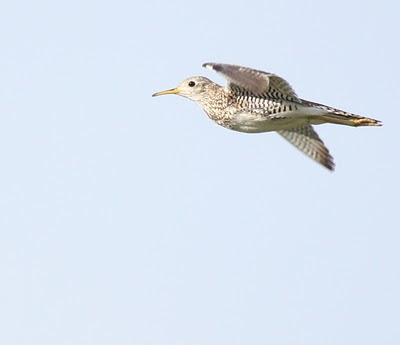


Another prairie shorebird, the willet, flew over while I retreated.


Turkey vultures often wait for the sun to warm the air in groups along fencelines. On my return drive, I found eight of them perched on eight fenceposts, lined up like some kind of grim tribunal of old men. Here is a shot of one of them.


Here are the best shots of ruby-throated hummingbirds I could manage this summer. First a couple of females in flight . . .
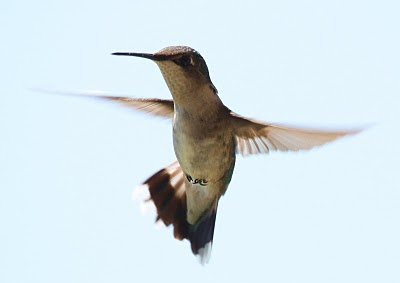


. . . and two shots of a male perched (when the sun is not hitting the gorget directly, it turns black):


Two pairs of Eastern Phoebe nest in buildings on the property. This one was flycatching for the young in its nest by sallying out over one of our garden plots.


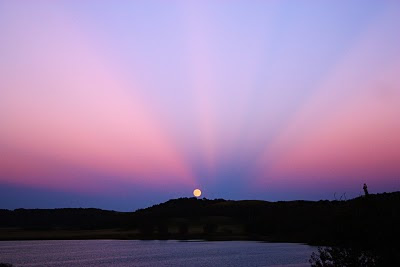
In late July we had a moonrise that shot the sky with colour and streams of light after a rain shower.


The next morning, July 26, was calm so I rose early to see what grassland songbirds I could find in the western part of the pasture land. Here is what our little valley looked like, with strands of mist hugging the hills and lake, as I drove up onto the prairie:


The first birds I heard were Grasshopper Sparrows, singing from barbed wire perches.


Here is a closer view of one singing:


Nearby I found a lone Sprague's Pipit, as usual several hundred feet up in the air--damned near impossible to see with the naked eye and still only a smidgen through my 400mm zoom lens.


I saw a handful of Western Meadowlarks that morning. This was the only one who allowed me a photo of his yellow breast. Something about this pose and the shape of the chevron on his breast reminds me of the Fred Lahrman painting on the cover of GSS.


These young Brown-headed Cowbirds were feeding among a herd of Angus on the pasture.


This summer we followed the fortunes of a pair of Cedar Waxwings who nested in the lilac hedge near our cabin. Here is photo of an adult on the nest on July 13:


When it flew off to feed, I snuck a shot of the eggs.


By August 2, the nest looked like this.


As far as I know, three young waxwings fledged.

Next posting, I will show some images from a holiday to the Okanagan, which has perhaps the rarest kind of grassland in Canada.

Friday, August 6, 2010

If grasslands are "like the freezer" no wonder we have so little left


gauchos on the Argentine Pampas

Out at the cabin for the last couple of weeks, I haven’t been able to post to Grass Notes, but when I get some time I will post some photos from the summer. Meanwhile, here are a couple of thoughts on grassland conservation that have been on my mind:

My ecologist friend, Rob Wright, told me recently that out of the 1.2 million acres of land in the Regina Plain Landscape Area (or ecodistrict K17 - on the Ecoregions of Saskatchewan map), a mere 450 acres still have their native grass cover. That means 99.07% of the native grass on the Regina Plains is gone. What can one say about that kind of annihilation?

Carla Sbert of Nature Canada sent me an article from the June 2007 issue of WorldBirdwatch, entitled “The Tyrant and the Gaucho.” It is about grassland conservationists in South America facing the same issues we grapple with in this hemisphere. Asked why grassland seems to be so undervalued compared to other kinds of natural cover, Anibal Parera, BirdLife International’s Coordinator of the Alliance for the Conservation of South America’s Southern Cone Grasslands, says “For most people, grasslands are like the freezer—a place where their food comes from. When they think of grasslands, they think of cows, crops, and horses. When people think of forest, they think of jaguars, owls, toucans. . . .” Anibal’s colleague Rob Clay added, “the changes resulting from grassland conversion are less dramatic than those caused by rainforest deforestation, so to the untrained eye there is little difference between a grazed pasture, cereal crops, and pristine grasslands.”

Share this post

Get widget