Friday, December 3, 2010

Loving the Bobolink


Male bobolink nesting in the meadow on the east edge of Cherry Lake.


This week a friend, Joe Kotlar, came across a disturbing editorial written in a farm publication from Ontario, Farmer's Forum, which claims to be "Ontario's Leading Farm Newspaper". The editorial is entitled, "Latest threat to farming — bobolink and biodiversity zealots"

Click on the link above and give it a read, but don't assume that this kind of embattled thinking represents all of rural Canada. Farmers are as diverse a bunch as any other group of human beings. While some enjoy having birds like the bobolink on their hayfields, and will consider taking measures to protect them, there are, unfortunately, those who see any wild animals on their land as a potential threat to their bottom line. It's this vocal group who often succeed in talking legislators into things like coyote and wolf bounties; who oppose any designation of an endangered species and who live in fear of some government employee telling them what they can or cannot do with their land. Between the extremes of farmers who have found a way to make a living by working with nature and those who see themselves in a pitched battle against the wild, there are those who are aware that their land is providing carbon sequestration, biodiversity, water filtration and other "ecological goods and services" (EG&S) that benefit the wider human and natural communities.

And at the same time, they know that these EG&S do not contribute to their short term bottom line and in fact they can make more revenue if they opt for farming practices that reduce habitat, pollute waterways, and increase their carbon footprint. From there it is not far to the assumption that they should be paid or compensated somehow for not choosing to degrade the EG&S their land contributes. This logic will sometimes lead farmers to say things like, "we are providing these EG&S and we should be paid for them."

That has a "truthy" ring, as Stephen Colbert would say, but of course we all know the real truth here: i.e. that it is not farmers but the biosphere itself that is providing the life-sustaining systems we depend upon. Farmers are not entitled to hold the commonwealth of clean air, water, and biodiversity ransom, but neither are the rest of us entitled to the cheap food that industrial agriculture ensures. A cattleman who keeps his land healthy and provides habitat will have higher production costs than those who push their land to minimize costs and maximize revenue. That reality means that today healthier food from healthier land is a luxury that only the wealthy can afford.

But what if there was a way we could agree that EG&S are a collective commons we must all take responsibility for? We would then all begin to share more of the embodied costs of protecting wildness on our farm landscapes, but even more important, we would begin to find regulatory instruments and disincentives that would increase the costs for anyone--farmers, industrialists of any kind, developers--who wants to drain a wetland, bulldoze a poplar bluff, or cultivate native grassland.


preening bobolink

As things stand, we have a cheap food policy that drives our over-heated economies and unsustainable development, and it has fostered a kind of agriculture that pre-selects for farmers who see the bobolink and any creature not increasing yields as an enemy. We all need to help turn this around so that it becomes possible once again for farmers to love the bobolink.


Female and male Bobolink together

Wednesday, November 24, 2010

Late Autumn Birds of Cherry Lake


White Birch holding yellow.

I have been meaning to post a few photos of birds from this fall's bird walks at Cherry Lake and other spots in and around the Upper Indian Head Creek Valley. I found a flock of 20 mountain bluebirds in a small pasture north of the Squirrel Hills. They were loosely associated with a small flock of warblers, including this Yellow-rumped. . .


. . .and this Palm Warbler. . .


The bluebirds flew around me for a while. . .


I burrowed myself a spot in the slough grass next to a small pond with a few ducks, and waited for the bluebirds to settle. . .


. . .finally a male landed.


Here are some of the sparrows I was able to photograph this fall. A Harris Sparrow. . .


One of the rarer sparrow species at Cherry Lake in migration is the Swamp Sparrow. I think we have two or three records in six years. Not a great photo, but so far my only chance to get near enough to a Swamp Sparrow to even attempt a photo.


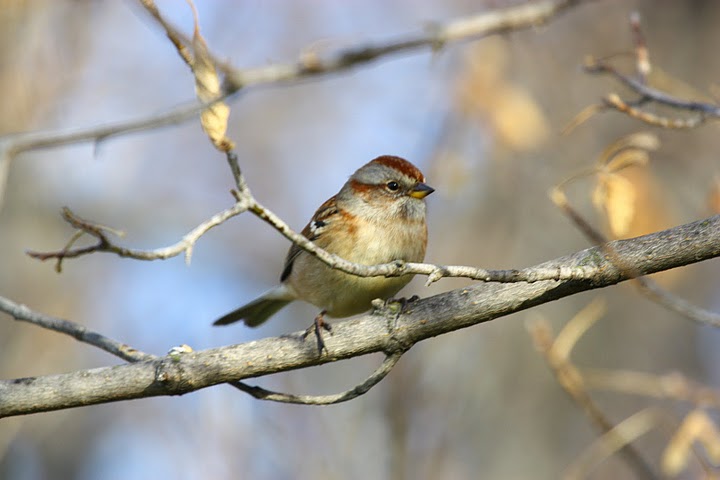
One of the commonest and definitely the latest sparrow species is the American Tree Sparrow.


As the hawk migration continued, we saw this little guy over the yard site high and heading south. A Sharp-shinned Hawk.


And the largest raptor we see regularly on migration is the Bald Eagle. This sub-adult flew over me as I was waiting for the Swamp Sparrow to emerge next to one of the beaver ponds in our valley.


This is the last Turkey Vulture I saw in 2010.


The last buteo hawk we see each fall is the Rough-legged. This one passed through on a warm day in early November.


With the sun almost down, and the leaves all on the forest floor, here is how the hills looked south of the lake the day the Rough-legged flew by.

Wednesday, November 10, 2010

Don't give up--there are still ways to stop the Outlook Feedlot


This postcard shows a river that is still safe for swimming. . . .

Sure, the R.M. has dodged the petition, for now, but there are still ways to slow down and then halt this project. Opposition will start to build as the people of Saskatoon wake up to the truth that their river could receive run-off containing growth hormones and antibiotics from the province's largest feedlot. Meanwhile, those of us who are concerned must let our own MLAs know, as well as Jim Reiter, the MLA in whose constituency this feedlot is to be built. Please write a short and polite letter and address it to:

Hon. Jim Reiter, MLA,
Box 278, Rosetown,
SK S0L 2V0.

While you are at it, why not send a copy to Premier Wall and Dustin Duncan, our Environment Minister?

The Honourable Brad Wall
Premier of Saskatchewan
226 Legislative Building
Regina, SK S4S 0B3

The Honorable Dustin Duncan
Minister of Environment
Room 315, Legislative Building
2405 Legislative Drive
Regina, SK S4S 0B3

Meanwhile, if you are looking for inspiration, read this wonderful letter I received recently from an Alberta friend, Don Ruzicka, who has appeared in this space before. In my mind, Don, an award-winning organic producer, is one of the wisest farmers on the Canadian Plains. Have a look at his web site when you get time.

Anyway, here is Don's letter, verbatim, but first an excerpt from his email to me, which read as follows: "Since I have become more connected to nature over the past 14 years through changes in the way we farm, I have noticed that the land, nature, the environment or Creation (whichever you choose to call it) are more forgiving. This "gift" has been passed onto me.

The riparian areas were running on empty; wetlands were drained or pugged from overgrazing; the pastures were overgrazed and going backwords and many trees had gone south. After doing a 180 with regards to the way we manage the land, it has been steadily coming back to good health. For me, this is a sign of forgiveness for what I had done to the land and is also a catalyst for my own spiritual health. When one has been forgiven so profoundly, it is hard not to reciprocate.

Wendell Berry would be able to share some wisdom with the people of Outlook. He writes that when land is farmed in the right way, with respect and love, it has a positive affect on those who see it develop. Conversely, the opposite is also true. Are the people of Outlook even remotely aware of this or has their good sense been subverted by the promise of economic development and all of the so called "prosperity" that it will bring?"

Now the letter he enclosed:


Hi Trevor,

You have explained the issues well and there are no easy answers. Some people see opportunities while others see quality of life being compromised along with the environment that they live in. The result is the polarization of the community. Cases like this make me think that we have to re-define ”progress,” sooner than later while we ponder what we want the future to hold for our children and grandchildren.

Farming publications quite often contain articles on how important it is to know your cost of production as well as the economic benefits of various agri-business ventures. I have yet to see a story on the “cost of destruction.” You give a good example of “destruction” with the picture of a riparian area damaged by cattle. These areas, when healthy stabilize creek banks, remove toxins from the water, filter run-off, sequester carbon, provide habitat for fish, increase biodiversity as well as many other benefits. I had a damaged riparian area like this and it took me 10 years to bring it back to good health after fencing it off from the cattle.

A report was recently released on a study that was done on two southern Alberta rivers. A species of fish was found to have 85 to 90% of the population to be female and some of the males had eggs in their testes. This is referred to as “gender bending.” Normally, 55% of populations are female. These fish are responding to estrogen-like compounds in the environment. Some of the highest counts were in an area where run-off containing antibiotics and growth hormones from a feedlot entered the river. If there is no river, where does this run-off go? The fish are telling us what is going on in the environment just like canaries used to tell miners when it was time to get out of the mine shaft.

I think that if we were to tally up the costs of bringing our surface and groundwater back to good health, this “cheap beef” would be very expensive. I believe that consumers are becoming more discerning in their food choices and are acknowledging that caring for the land has a cost that should be included in the price of the food. And yes, we have a long way to go.

The Amish have a message when it comes to making decisions regarding the land. They understand that their community is a part of nature, not above it. When an opportunity involving innovation, technology or change comes to their community, they ask the question; “How will this affect our community?” They feel that when they do damage to the land, they also do damage to their community as well as their relationship with the Creator. Perhaps we need to become a little bit Amish.

Don Ruzicka,
Killam,Alberta

Friday, November 5, 2010

Birdline on Monday--a question about Saskatchewan's Provincial Bird, the Sharp-tailed Grouse


This amazing photo of a Sharp-tailed Grouse in dancing form courtesy of John Carlson, friend and a great defender of grassland birds. Here is his always beautiful blog, Prairie Ice.

I'll be on Birdline our (now) bi-monthly phone-in radio show about birds, beginning at 12:30 p.m. next Monday (Nov. 8). During the show, I will be asking listeners to call in and answer two questions: 1. Are they seeing many Sharp-tailed Grouse (or "prairie chickens") in their region and 2. Do they agree that it may be time to close the hunting season for this species.

This morning, Fred Clemence, a retired farmer who has been paying attention to birds for many years in Saskatchewan's parkland eco-region, called to express his concerns over the Sharp-tailed Grouse. "I've been trying to find someone in the provincial government who will take me seriously, but no one will listen."

Fred believes that it may be time to close the Sharp-tailed Grouse season and give the birds a chance to build up their numbers. The best data available shows an unquestionable and statistically significant decline. The Breeding Bird Survey (BBS) run by the U.S. Geological Survey's Patuxent Wildlife Centre and the Canadian Wildlife Service, shows that in Saskatchewan the Sharp-tailed Grouse is declining by 7.2% per year. In Aspen parkland the annual decline is 11.3%!!

Hunters and the hunter-biologists working for Saskatchewan Fish and Wildlife are fond of studies that supposedly demonstrate that hunting has little effect on a species like the Sharp-tail, even when it is in steep decline as it has been in recent decades.

I'm not convinced that is entireley true, but even if it were true, why not give our prairie upland game all a bit of a break anyway and let them increase and expand outward from zones where they are reasonably plentiful? Even if there is no guarantee that would happen from a moratorium on hunting, it would at least be a sign of good faith that the agency responsible for managing these species is concerned about their decline and looking for ways to help them recover. What else is Saskatchewan Environment doing to reverse this death spiral? What have we got to lose if we close the season for a few years?

As Fred said in his phone call, sharp-tailed Grouse dancing grounds are getting very empty in the parkland where they once were common. There definitely has been some habitat loss, but not commensurate with the decline in Sharp-tails and Grey (or "Hungarian") partridge. Something else is emptying the dancing grounds and habitat, but no one seems to be trying to find out what that is. As long as there are still decent numbers of Sharp-tails in the large pastures near the U.S border where hunters can have a good day of shooting, our Fish and Wildlife officials seem to be happy.

Instead, we should be looking to secure more habitat and perhaps allowing the few birds remaining in the south to flourish in hopes that their much-retracted zones of healthy population might actually expand back to the north.

If you have some thoughts on this, please phone in to Birdline on Monday and share them with our listeners.

Tuesday, November 2, 2010

Outlook Feedlot: Responding to Economic Arguments


I’ve received several comments on my posting about the feedlot proposed for Outlook, but one in particular got my attention. A local farmer, Murray Kasper, took some time to compose a dissenting comment (shown at the end of this post), arguing for the feedlot on economic grounds. His arguments were made with thought and care and deserve a careful and thoughtful response.

I agree, of course, that the beef industry is “market sensitive” and “affected by economics of scale.” Murray mentions a former program that at one time allowed him to finish his own calves with grain, sending them to Intercontinental Packers in Saskatoon for slaughter. Those days are gone, as we all know, because of radical consolidation in the industry. Intercon is gone and two companies, Cargill and XL Foods, now do 80 per cent of the beef processing in Canada. Farmers like Murray who want to process their livestock through the mainstream markets have no choice but to sell their animals to large feedlots, primarily in Alberta, serving this duopoly.

Who benefits from this system? Well, the feedlot owners do okay, and the biggest ones with deep pockets do best, riding out any fluctuations in the cost of feed grain and fuel. Farmers growing the barley at prices cheap enough to feed livestock can do well for a while if they too stick with the “economics of scale” program and get really big.

The meat packers, though, are the primary beneficiaries. They control everything from the price of feed grain to the animals sold at the farm gate to the supermarket. And here is how they do it: companies like Cargill and XL buy their own feeder cattle and have them “custom-fed” in feedlots. This means that they do not have to buy directly from independent sellers if they don’t want to. When livestock prices rise, the big packers can just step out of the market for a while and instead of paying the current price use their own supply of cattle purchased at lower prices. Because of their size, when the packers stop buying for a spell they cause a backlog in the market among independent sellers and ranchers, leading to an artificial oversupply that drives down prices. When the price falls enough they buy more cattle. This 2009 article in Alberta Views said that, adjusting for inflation, the average price farmers received for a steer in 2009 was half what they got in 1969.

However, as Murray astutely points out, consumers are the ones who want their meat cheap--which means the meat-packing corporations can always blame consumers for everything from predatory market practices to environmental damage, saying “Well, you don’t want to pay higher prices for beef do you?” As long as that is true, the beef-buying public remains the ultimate beneficiary of an unfair and unsustainable system, complicit with the greed of the big corporate meat packers.

Who are the losers, though, the ones who are paying the ecological and social costs of this system? With farm gate prices for steers so low, producers end up grazing their pastures harder than they might want to, which decreases biodiversity on their land, degrading habitat for some of the most endangered species in North America. Squeezed between rising costs and falling prices for their animals, they often cannot afford to take measures to protect the quality of their grazing land and riparian areas.


riparian zone damaged by cattle

The only way to keep their income at a reasonable level is to play the economies of scale game and get as big as possible. The traditional small cow-calf ranchers, once the backbone of our beef industry, are replaced over time by the big operations that buy young animals cheap, let them graze until they reach feedlot size and then sell them into the meat-factory system. Our once proud cattlemen and women are being replaced by functionaries working at one end of a conveyor belt that terminates in the supermarket meat department. In between, a lot of destruction is happening, in both ecological and human communities. Take a drive through Saskatchewan’s southwest or Alberta’s rangeland and talk to the ranch families that remain. Ask them what this system is doing to their families, their neighbours, and the future of ranching. Then ask the men and women who sell cattle that end up in feedlots where they get their meat from. Most will say that every year they “finish” a couple of steers themselves for friends and family and many will admit off record that they wouldn’t eat feedlot beef themselves because of the hormones and drugs that get into the meat, not to mention the risk of e Coli.

Given this dysfunctional and wholly unsustainable system, should it be reassuring to the people of Outlook and the RM of Rudy to hear that local feed grains and calves will be bought by Namaka corporation to process through the feedlot? Perhaps it is good news, if everyone can close their eyes to the social, human health, and environmental costs of encouraging cheap, industrialized meat production instead of working to support the alternative: local livestock rearing on ranches where producers are paid a fair price for their animals, which are either finished on grass (the best alternative for ecological and human health) or else finished on grain in small local operations.

All of this, of course, implies consumers willing to pay for healthier meat. That is not going to happen tomorrow, but the writing is on the wall. At some point, enough consumers are going to be demanding healthier meat with a smaller ecological footprint that feedlots will be closed down. A relatively small one farther away from the meat packers will be first to go. Do the people of Outlook and the RM of Rudy want to roll the dice and see how far this ride takes them, regardless of risks to the local environment or the water quality of the South Saskatchewan River? Or do they want to be part of the solution and find better ways to support local livestock producers?

People of Outlook and the RM of Rudy, do not be seduced by “ends-justify-the-means” thinking. Cargill and XL don’t need your help, but all of us, from consumers to producers, need communities to draw a line in the sand and say “no, this is not good for any of us in the long run.”


Click here for Westbridgeford Meats Website

[Here is Murray's comment]
Dear Trevor, I am a livestock and grain producer in the RM of Rudy. Our farm is 12 miles straight north of the proposed Namaka Farms site. I am disappointed that you have chosen to advocate the inaccurate and misleading information put forward by the Rudy Ratepayers Group.

The Rudy Ratepayers Group does not represent the majority of residents in the RM of Rudy and I believe it is headed up by a land speculator from BC who only resides here for a short time during the growing season.

The beef industry is very market sensitive and thus is very much affected by economics of scale. I know this personally, as we finished our own calves for market back in the 80's when the Provincial Beef Stabilization Program was operating. When that program was discontinued, so was our finishing operation and at about that time, Intercon Packers in Saskatoon stopped slaughtering cattle. That is the kind of economic activity we don't want to see. If you can convince the consumers of this great country, and the world for that matter, to pay considerably more for poorer quality beef, then you will see a change in the beef industry.

As far as M1 Canal is concerned, water leaks out of that thing, not into it.

The 36 full-time permanent jobs expected to be created, while being very welcome, are a small part of the economic activity that will spin off of this development. Nothing has been said in regards to the construction or the feed and calves that will be sourced locally. Anyone who thinks that Namaka Farms won't source it's calves and feed locally as much as possible, is out of touch with reality and knows nothing about the beef cattle business.

Of the four residents in close proximity to the site, that are opposed to the development, two are acreages which are not agricultural producers and contribute very little to the tax base of the RM. I was told all of the residents in the immediate area of the site have been visited personally by members of the Thiessen family, to address their concerns.

I hope these comments bring to light some of the reasons why most of the grain and livestock producers in the RM of Rudy are not opposed to this development.

Sincerely, Murray Kasper, Outlook

Friday, October 22, 2010

A Feedlot for Outlook?


The Rural Municipality of Rudy, including the town of Outlook, Saskatchewan, has been considering a new 36,000 head of cattle feedlot, which if it goes through would be the largest in the province. As always, these intensive livestock factory issues divide the community into those who support the proposal (they see the jobs and the increased tax base), and those who do not want the pollution, traffic, smells and so on. The matter was to be decided last night (October 21, 2010) in a vote at a meeting of the R.M., but, just before the meeting began, a petition was presented to the Reeve and councillors, calling for a referendum. In response, council gave its administrator a month to determine if there are enough signatures to force a public vote.

The good people of Outlook and area have a month’s breathing room now, in which they can ask themselves some important questions:

1. Is this really a “Not in my backyard” issue or is this a matter of saying “no, feedlot beef is not good anywhere”? There are other ways to raise beef--and all of them are much healthier for people and ecosystems. This province not that long ago was able to raise beef without intensive feedlot operations and the threats to human health, drinking water, human health and the environment that they pose. Saskatchewan people who think about these things are switching to grass-finished beef either from local producers or from outfits such as Westbridgeford Meats in Tugaske.

2. Is the possibility of 36 jobs (that is what the corporation proposing the feedlot projects) and some tax revenue a fair trade for all that will be lost to the beauty and wellbeing of your land and waterways in the Outlook area? Would you allow a toxic waste dump in your RM simply because it would be good for the economy? [Note: a reader, "localfarm" sent a comment advising me that in fact there will be "no additional tax revenue from this feedlot as it is a family farm & will pay no more tax than what it they are already paying." This reader also pointed out that Saskatchewan taxpayers will be on the hook for this boondoggle. The provincial government is promising to build a primary highway to serve the feedlot and to fund any infrastructure costs the Rural Municipality incurs because of the increased traffic, etc.]

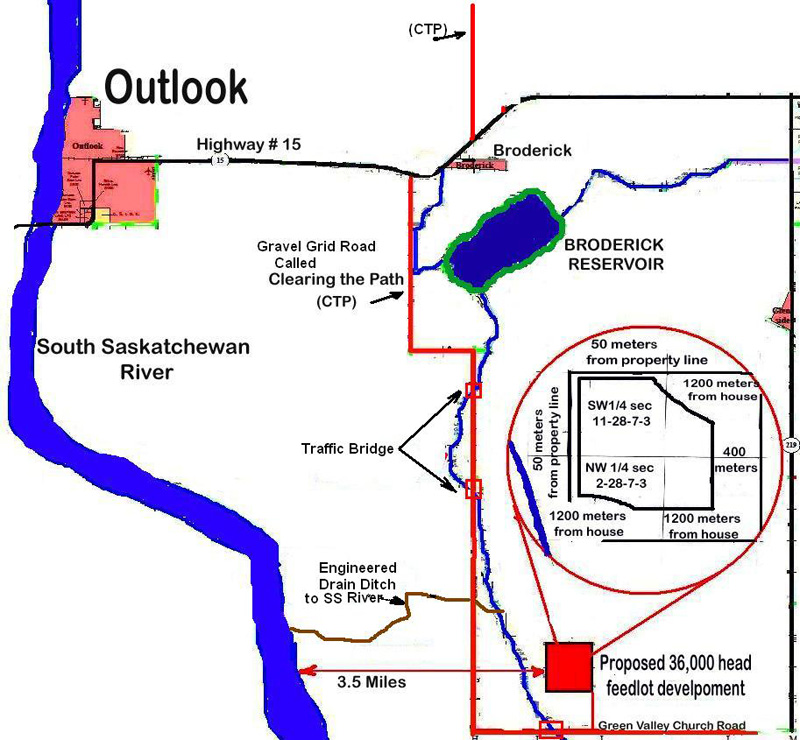
3. Do you want to raise your tax base and create jobs in an industry that needlessly breeds E. Coli (incidence in Saskatchewan feedlots is as high as 57%; E. Coli only happens when you feed cattle grain), that has a strong chance of polluting the drinking water of downstream communities dependant on the M1 canal? [A reader, "localfarm," points out that the proposed feedlot would be 500 metres from the canal and four miles uphill from the South Sask. River.] Take a look at this map provided on the ratepayers' website devoted to this issue:


4. Do you really want to entrust the public commons of air, land and water quality you share as people of the RM of Rudy to a factory-farm owner from Alberta who has come with his proposal simply because he has no more room at home and Saskatchewan has cheaper land and no one really protecting the water? The people who settled the RM of Rudy were farmers, but this man is an industrialist and a businessman.


Standing next to cattle in a photograph doesn’t make you a farmer.

Read more:
story from last night's meeting covered on CBC website.

The excellent website created by the people of Rudy discussing this issue.

October 13, 2010 Regina Leader-Post article on the proposal.

Wednesday, October 13, 2010

Thanksgiving Bird (no, not a turkey, a prairie pileated)


A misty Cherry Lake morning on Thanksgiving weekend

I've spent more than my share of time lamenting the birds that are declining from the grassy heart at the centre of this continent, thinking and writing about the species I no longer see as often as I would like. On the weekend, as we prepared to celebrate a Thanksgiving meal at Cherry Lake with our good friends Rob and Sylvie and their family, I had an encounter with a woodpecker that taught me to be grateful for the birds we do see, the ones that seem to be adapting and making a go of it.

The kind of prairie we have on our land, Aspen Parkland, is part of the most threatened grassland eco-type in the province. There have always been some trees in this kind of grassland, but under agriculture, with fire suppression, cultivation and cattle-grazing, some areas have seen Aspen bluffs maturing and expanding. (I say "some" because recent cropping practices and the increasing scale of farm machinery with rising input costs, have stimulated a lot of bulldozing of bush in heavily cultivated regions.)

More Aspen and larger trees is good news for a whole guild of bird species. Species like the Red-tailed Hawk are obvious beneficiaries, but for my money the bird that is really moving out from the boreal forest and adapting to the Aspen plains is the Pileated Woodpecker.

For six years I have been hearing and seeing Pileated Woodpeckers in the woods upstream of Cherry Lake in a tributary of the Upper Indian Head Creek. Despite the hard work of a dozen beavers in three lodges along the stream, there are Balsam and Aspen poplars in the ravine that measure 18 inches at the butt--perfect for attracting the largest woodpecker we have in this country.

They can be secretive much of the year and getting a look at one is always a treat. In fall, woodpeckers become more active and roam far and wide from their territories. It's a good season to see them. The last few weeks I have heard a Pileated calling from the woods upstream of our farm site. Each time I have grabbed the camera and headed out hoping to get a shot. I have several images of blurry trees and empty sky taken while one of the birds circled me through deep woods.

This weekend, though, with Sylvie's Thanksgiving supper sending good smells out into the yard, I heard someone yelling for me to come. It was Rob, down at a future garden site where he is using tarps to kill brome grass and other weeds: "It's the Pileated!" He was pointing at a few dead aspen that we have left next to the lake shore in front of the yard site. Grabbing the camera, I scanned the trees and saw nothing. It was a dead calm day, though, and something was moving the tall brome grass at the base of a broken off snag. Here is a shot of all I could see at first.


If you squint at the centre of the image you can see some of the red, white, and black pattern on the back of the woodpecker's head as he works on an old stump buried deep in goldenrod, brome grass, and thistle. I snuck through the grass and got as near as I dared, staying low and waiting for it to emerge. Then, to my amazement, it hopped through the dense grass to the base of another tree twenty feet away, whacking away at ground level, shaking the grass to and fro, before finally hitching upward on the trunk and into view. With late afternoon light behind me I was able to get a couple of photos.


Before I left to go set the table for supper, it moved on to more distant trees, flying part way and then diving down into the grass. This, I thought, is a bird that's going to make it here out on the plains as long as we have trees big enough for them to forage on and nest within. Yes, the grassland is changing and many of the birds who need open treeless plains are suffering, but at the same time, I can be grateful for the adaptive birds that are thriving. At grace that evening, with candles lighting a table full of good food grown on prairie land, I thought of the woodpecker and gave a silent thanks for wild drumming in spring, jungle cries rising from the ravine, and a red-crowned flourish passing through dark woods.

Share this post

Get widget