Saturday, February 14, 2015

Sowing the land with hope: Sunrise Farm

Gate sign at Don and Marie Ruzicka's farm--for the Ruzicka's, the meadowlark is a symbol of the land's recovery

This week I am posting a story from a friend who reads Grass Notes from time to time. Don Ruzicka is a farmer who has found ways to make a living growing food while keeping the ecosystems on his land healthy and alive. Sunrise Farm, his 800 acres of prairie parkland near Killam, Alberta grows pasture-fed chickens, laying hens, turkeys, beef cattle, and hogs, but it also grows some native prairie, badgers, Mountain bluebirds, Sprague’s pipits, and a long list of other birds including 18 kinds of waterfowl.

a Mountain Bluebird nesting in one of 240 nest boxes Don has erected

I remember once Don telling me that he believes our agriculture is compromising who we are as a "prairie people". He believes that, while it is important to be financially sustainable, those who switch to more ecologically sustainable models experience a change, a "peace and contentment” that comes from rebuilding and restoring the integrity to the land that industrial agriculture eventually destroys.

I invited Don to write a guest post for Grass Notes, describing that shift he and his wife Marie made away from conventional high-yield farming toward peace of mind.

Here is his story, along with a string of photos at the end--all provided by Don:

A question that I have long pondered regards the definition of “success” when it comes to farming. I read many agriculture publications and the picture that comes to mind is that it is based on the number of acres owned and rented; the size and how new the tractor, combine, air seeder, sprayer, grain hauler and grain storage system are. The latest SUV and pick-up also appear to be key indicators as well as a condo or home in some “away” place where the mercury favours the top end of the thermometer.

When we moved to the farm in 1983, many of the above were on my radar of possible achievements. We grew grain and raised cattle for the commodities market. Our debt load spiraled out of control. To stop the bloodletting, I began to clear trees, work up wetlands and sloughs and turn native prairie upside down in order to grow more grain. The short story regarding this first chapter of our life on the farm is that I failed. I could find many excuses but in all honesty, my management decisions were not sound. I took on too much debt along with expectations of bountiful crop yields and high grain prices.

Our debt load ballooned to where there was no way out other than to sell the farm or change the way we farmed. We signed up for a holistic management course in the fall and winter of 1995-96. This course was quite humbling for me. We learned that those wetlands, sloughs, trees and native prairie that I had found to be expendable, were essential pieces of the prairie ecosystem. When we finished the 8 day course, we were excited because we could see there was a "way" that we could remain on the farm by going in the opposite direction; rebuild the ecosystem and move to an “organic niche market” way of farming. To erase the debt, we sold two quarters of land and all of our grain farming equipment.

We seeded all of the crop land to pasture and began planting trees and restoring the wetlands. Our new grass based model of farming was taken from Joel Salatin’s example where he pastures poultry and hogs and raises cattle on a total forage diet. It is an agrarian way of farming which does not depend on expensive technology and is considerably more labour intensive than conventional agriculture.

According to a study by the World Wildlife Federation, our planet has lost 50% of its wildlife since 1970. I had no idea that these parts of the prairie ecosystem that I had trashed, when we first began farming, were necessary to provide food, clean water and air for essential human wellbeing. I had not consulted what author Wes Jackson refers to as “the genius of place,” or, “what does nature require of me here?” Rather, I had imposed my own will on the land which I call “farmer knows best.”

It is puzzling to some that rather than seek advice from the agri business dealer about what our farm requires, I now consult with riparian specialists, waterfowl biologists, ornithologists, entomologists, agroforesters and ecologists. These folks offer advice on how much to take and more importantly, how much to leave.

Authors Wendell Berry and Aldo Leopold have been welcome teachers on the journey. Wendell writes, “when we realize how much is enough; we know how much is too much.” This way of farming has taught us how much is too much. If we want too much, the land pays the price. Leopold’s definition of a land ethic is that “it reflects the existence of an ecological conscience which in turn reflects a conviction of individual responsibility for the health of the land.”

I have had the conversation more times than I care to remember about which comes first; financially sustainable or environmentally sustainable? I don't win too many debates when I explain that environmental sustainability must come first. I have seen examples of farmers who make the money first and then there seems to be improved technology that needs to be purchased and there is never enough money to restore the ecosystem side of the equation and nature loses--again.

If there is going to be a future of hope for those who come after us, I think we will all have to lower our expectations of what we need to be happy and that is an uncomfortable discussion for many. There is not a meal that we sit down to where we do not give thanks. We feel that we are blessed to be able to enjoy the bounty of the land and often everything but the salt, pepper and milk products are from the farm. Perhaps we have selfishly redefined "success."


Don says that the badgers "have landed immigrant status on our farm. They roam our pastures and keep the gopher populations in check without the use of strychnine"


Female bluebird on the nest

Annual bird surveys turn up more than sixty species on the farm
Hog shelters hooked onto a retired Doepker rod weeder.  Shelters are moved twice daily
Don: "After fencing off our 10 dugouts, dragon flies made a come back as we had unknowingly created habitat for them.  They are policing the grass hopper populations on the farm."
Two row shelter belt with maples on the right row and a variety of berry bushes like sea buckthorn, buffalo berry, hawthorn, chokecherry and pincherry in the other.  These diverse shelterbelts provide habitat for many birds but also native pollinators.  The closer to the shelterbelt, the more prolific the alfalfa grows. The snow trapped by these trees also provides moisture for the pasture
cattle grazing along electric fence with new wildlife plantings (Don has planted hundreds of thousands of bushes and trees on the farm)


An "eco-buffer" planting made with support and consultation of the PFRA shelterbelt system before the Harper government gutted the program


Saturday, February 7, 2015

Bring back the Great White Birds of the Plains--Part II

this lovely image courtesy of Val Mann


Not far from the town of Kerrobert in west-central Saskatchewan, sixty some kilometres east of the Alberta border, there is a series of large wetlands--broad, alkali marshes--where the prairie Whooping Crane in the early 1920s made its last stand. It is believed that this small remnant was one of the last groups of free-nesting Whooping Cranes to breed anywhere outside Wood Buffalo National Park.

Bill Cholon of Luseland, born in the dustbowl of the 1930s, recalls his father speaking of the big white cranes or “herons” that nested at one of these wetlands, which is still known as “White Heron Lake.” His father told him he saw Whooping Cranes nesting in the early 1920’s after a great prairie fire roared over the plains, forcing them to flee to the eastern shore of the big marsh.

Here is a satellite image of the lake today:


The next to last official nest record for Whooping Cranes outside Wood Buffalo N.P. (and at the time no one knew about the Wood Buffalo breeding grounds), comes from a few miles away from White Heron Lake at another wetland near the town of Baliol, which no longer exists.

The nearest large slough to Baliol today is called “Shallow Lake,” sometimes called “Baliol Lake,” a couple of miles to the southwest. Here is a satellite image of Shallow Lake:

If you know anything about the way native prairie looks on satellite photography, you may have already noticed that both of these large shallow lakes are surrounded by native grass. In fact, each of these historically and ecologically significant wetlands exists on federal PFRA community pastures. Shallow Lake is part of Progress Community Pasture in the Rural Municipality of Progress and White Heron Lake is in Mariposa Community Pasture in the Rural Municipality of Mariposa.

Kerry Finley grew up not far from these prairie wetlands on a farm close to Luseland. Kerry is a rare biologist (spent much of his career in kayaks studying Canada’s Bowhead Whales), whose respect for natural history and other forms of traditional and non-scientific knowledge has gotten him in trouble from time to time. An inveterate and some would say irascible defender of prairie wildness, he has dug into the story of those last Whooping Cranes, beginning with the local lore that came to him through his grandfather and other local Luseland people.

In the fall of 1922, Kerry’s grandfather, J.V. Finley, and a friend named Joe Perry, shot two Whooping Cranes at Buffalo Coulee, fifteen miles straight south of Luseland and a couple of miles southwest of Shallow Lake. Here is the photo taken at the time. (“Yvonne,” written at the bottom, was Kerry’s aunt, born in 1919.)


From today’s perspective, we are aghast that someone would kill a Whooping Crane (they actually shot three, but only retrieved two), but this incident occurred in a moment in Canada’s history when we were just beginning to enact laws and treaties to conserve birds. In 1918, Canada signed a new Migratory Bird Treaty Act, taking an important step toward protecting all migratory birds from unregulated hunting. Enforcement would fall to game guardians, men appointed by the Crown and paid abysmally to travel wide stretches of countryside policing the hunting and fishing practices of settlers.

On the 19th of May in 1922, the year Finley and Perry shot the Whooping Cranes at Buffalo Coulee, Saskatchewan’s first game guardian, Neil Gilmour, traveled to Shallow Lake to look for Whooping Crane nests. His notes say he soon found a pair of nesting adults but it took him hours of tromping the muddy margins of the lake before he came upon the nest in a small patch of open water: “The nest resembled a half-submerged cock of hay, flat on top and completely surrounded by water. Carelessly on the top of this mass of grass, was deposited the two large brownish-buff coloured eggs, about four inches in length.”

The story was written up with some enthusiasm by the great American bird encyclopedist, Arthur Cleveland Bent, recounting what he believed to be one of the most important nest records in his twenty-one volume, Life Histories of North American Birds.


That spring a total of three Whooping Crane nests were found in this part of Saskatchewan by Gilmour and others, two at Shallow Lake and a third at Kiyiu (Cree for “eagle”) Lake south of the town of Plenty, thirty miles away. In an exhaustively researched paper on Whooping Crane records published in the June 1994 Blue Jay, biologist Dale Hjertaas reported that another Kerrobert area observer, a man named Archie Smith, told Chief Game Guardian Fred Bradshaw that ten years earlier there were as many as twelve Whooping Cranes nesting at Shallow Lake.

In May of 2012, a century since that last concentration of nesting Whooping Cranes on the prairie, the famous conservationist and president and co-founder of the International Crane Foundation, Dr. George Archibald, traveled from foundation headquarters in Wisconsin to Regina to speak at a conference. A year before he had written to Kerry Finley to commend him on his article published in The Blue Jay, an article detailing the records at Shallow and Kiyui lakes as well as his grandfather’s story of shooting three of the last cranes. Finley ended the article stating that “as the whooping crane population continues to grow it will need to re-occupy this traditional nesting ground.”

During their correspondence, Finley invited Archibald to come to the area to see the last known significant nesting ground of the Whooping Crane south of Wood Buffalo. That May, Finley took Dr. Archibald to see the wetlands, accompanied by the PFRA Community Pasture manager. Joining the tour was Lorne Scott, long time conservationist and board member of the Whooping Crane Conservation Association, and old Bill Cholin, whose father had seen the great white birds at White Heron Lake when a prairie fire pushed them to its shores in the ‘1920s.

Bill kept his silence until just before the group walked over the fence and into Progress Community Pasture. Here is Kerry’s account of that moment:

“We were about to wrap up our roadside reconnoitre, when Bill brought out a manila envelope and unrolled a single yellow page. I was dumbfounded : “Whooping Cranes”, it read in bold letters, “also known as White Turkeys are in danger of becoming extinct”. It was a notice from Ottawa, signed by J.B. Harkin, [commissioner of Canada’s National Parks at the time and sometimes referred to as the “Father of Canada’s National Parks.”]. He said it had been found by a local man, in the abandoned home of Archie Smith in Kerrobert. At the bottom, in small type, I noted with exhilaration that it was dated December 1922.”


Why "exhilaration"? Well, that meant that that the official notices against killing Whooping Cranes were posted several months after Finley’s grandfather and his friend Joe Perry shot the three cranes.

Archie Smith is something of an unsung hero in this story. Smith took out a homestead on the shores of Shallow Lake and likely knew its cranes better than anyone. Finley believes that he was the one who guided Neil Gilmour around to the nesting sites at Shallow Lake, though he receives no mention in Bent’s Histories. 

Regardless, after 1922, the nest records at Shallow Lake and Kiyui Lake thinned out, and as we know the Whooping cranes stopped coming. In a letter Archie wrote to provincial Game Guardian Fred Bradshaw in 1932, he reported that he saw the last pair nest in the summer of 1928. They visited briefly in 1929, he said, but did not return in 1930.

When the Big Dry of the ‘30s hit, the lakes evaporated and blew away, returning in wetter decades as prairie lakes will. By 1941 the world was down to fifteen Whooping Cranes wintering on the Texas coast and no one had a clue where they nested. Wood Buffalo was not discovered until the mid-1950s.

What does this all mean? If Canadians want to protect its wild breeding population of Whooping Cranes, we need to help them start a second nesting site in this country. Breeding at a single location downstream from the blight and poison of Alberta’s tar sands, the species is in a precarious place.

For some time now, people in Whooping Crane conservation circles have discussed the pros and cons of re-establishing a second Canadian breeding population at a wetland complex on the plains.

Why not try it in Saskatchewan near the very centre of their historic continental range, as Dale Hjertaas once suggested? There are two or three locations in the province that may work, but there is something historically satisfying in the dream of re-establishing the species in the last place on the prairie where they were breeding in numbers a mere century ago.

Regardless of whether these large lakes are used to re-establish a prairie population of Whooping Cranes, two of them are on federal community pastures. These two pastures will soon be transitioned to provincial responsibility, where if all goes according to plan they will be managed by private cattle producers who will receive zero assistance or support to protect the public interest in this land.

As former Whooping Crane nesting areas, these places deserve better. The grazing patrons deserve better too, for they should not be handed the burden of protecting this heritage all on their own. Of course, this is but one story among many demonstrating that the heritage and ecological treasures of our community pastures are being placed at risk.

These grasslands form some of the largest contiguous blocks of original prairie on the Northern Great Plains. If it is not a story about Whooping Cranes, it is about a historic site where the Metis once lived, or it is about one of the last places where the yellow-bellied racer (an endangered snake) survives, or where Wallace Stegner spent his childhood summers and fell in love with the wild prairie.

Remembering the Whooping cranes that once depended on the wetlands of Progress and Mariposa pastures, can we not find a solution here? Is it not possible for public and private sectors to work together to balance grazing interests with the wider public interest in conserving heritage and ecological benefits? There are conservation NGOs who would like to help, the grazing patrons at the pastures would like to help, and there are many people in both federal and provincial public service who would like to help.

It is within our reach to sit down at a table and take a second look at how we manage the transition of the pastures in Saskatchewan, and to find a cost structure and creative management model that satisfies a range of public expectations here: for fiscal responsibility, for access to the pastures, and for protection of the heritage and ecological resources they contain. And, if we do it right, it should not have to cost the Province a dollar.

That may or may not happen one bright day but, at the very least, Shallow Lake, White Heron Lake, and Kiyiu Lake deserve to be designated with some kind of heritage and ecological protection. It might be nice to give Archie Smith some posthumous recognition for his service as well.

[Note: almost everything in this post is based on information passed on to me by Luseland naturalist, James (Kerry) Finley, or gleaned from back issues of The Blue Jay (the natural history journal of Nature Saskatchewan), specifically Hjertaas, D.G. 1994. Summer and breeding records of the Whooping Crane in Saskatchewan. Blue Jay 52(2) : 99- 115; and Houston, C.S. 2010. Saskatchewan’s First Game Guardian: Neil Gilmour, 1859-1940. Blue Jay 68(1): 41- 44; and Finley, J.K. 2011. Return of the Golden Bird: the last breeding ground of the whooping crane on the prairies. Blue Jay 69 (2): 88-94..]

Saturday, January 31, 2015

Bring back the Great White Birds of the plains—Part 1

plains bison at Grasslands National Park, image courtesy of Hamilton Greenwood


Before the first wave of settler agriculture on the Great Plains, both here and across the border in the U.S., our ancestors had all but eradicated the largest and fiercest mammals: the bison, grizzlies and wolves.  Like the indigenous peoples starved and swindled onto small reserves, wild grazers and predators would have to go before the open range cattle and sheep grazing of that early period could create a foothold for colonists. Although the native grass was still intact at the time (the mid to late 1800s), the sudden disappearance of these mega-fauna, and the plains hunters who managed the grass with fire, set in motion a cascade of ecological degradation that continues to be felt today on our remaining prairie landscapes.

There was a greater devastation to come, of course, thanks to generations of farmers and the John Deere plow, but notice something that happens when you read the story-line in the preceding paragraph. True though it may be, this story divides prairie people into two camps.

If you or your relations still live on the land, make a living in agriculture on hills and plains where once ran the bison, wolves and grizzlies, you get understandably nervous when this narrative is presented. Why? Because the other camp—mostly consisting of urban people, either does not care at all or, more dangerous, takes this story as the way things should be, the way things could be again.

These facts of our ecological history on the plains form the premise that has led many urban environmentalists to dream of and advocate re-introduction of these important prairie mammals. From the Buffalo Commonsproposed by Frank and Deborah Popper in the late 1980s to the more recent “re-wilding” movement, people easily get swept up in the romance of a restored prairie wildness.

It’s an attractive idea until you stop to think about what this would do to the farmers and ranchers who have lived for several generations on the land to be re-wilded. City folks love the wild in theory until a great horned owl eats muffy or a moose walks through the deck doors. Few prairie people, urban or rural, native or settler, would be content living with grizzlies chasing herds of bison through the landscapes they tend.

That does not mean there is not a place for bison restoration projects in conservation areas such as the American Prairie Reserve or Old Man on His Back, but any work done to restore elements of prairie ecology must involve and respect the needs of the people who make a living on and around our native grassland remnants.

Meanwhile, there is a large and charismatic prairie creature that could be returned to the plains and fostered in the right habitat without endangering the life and property of rural people.

I am thinking of the Whooping Crane.  It has been gone from our prairie landscapes for so long that we are inclined to think of it as a northern species that merely passes through the plains. But large prairie wetlands were once the stronghold of the Whooping Crane.

Whooping Cranes love the Saskatchewan prairie for staging on migration; is it possible they may once breed here again? (click on this image to see its three whooping cranes (left) with three sandhills (right) by permission of Val Mann)


Passing through the Eastern Qu’Appelle Valley in July, 1858, Henry Youle Hind wrote, “the white or whooping crane (grus Americana) was first seen today. This beautiful bird is common in the Qu’Appelle Valley and in the Touchwood Hills range.” (Hind, Narrative of the . . . Saskatchewan and Assiniboine Exploring Expedition of 1858)

While it was never as numerous as the Sandhill Crane, the Whooping Crane did nonetheless breed here and there across the northern Great Plains, perhaps moreso in its northern reaches and in the Aspen Parkland in particular.

This graceful, heart-stirring bird deserves to be back on the prairie where it evolved and spent its summers for thousands of years until our European ancestors arrived in the footsteps of explorers like Hind at the end of the nineteenth century.
                                      
With the arrival of thousands of farmers tearing up the ancient sods, draining wetlands and shooting every wetland bird large enough for the pot, the Whooping Crane rapidly thinned out.

Almost a century later, their descendants living on the land are asking, why not bring the Great White Bird back and see if a prairie population could be re-established?
                       
Next week, I will recount the story of a large wetland where the last Whooping Cranes nested in Saskatchewan, and a group of people who want to see the birds back where they belong.

(And my favourite part: it appears that the last whooping cranes to breed in this province were nesting on sloughs that are now part of two PFRA Community Pastures.)

 
with many wetlands recovering in recent years, is it time to bring back the Whooping Crane?


Thursday, January 22, 2015

More signs of hope for Saskatchewan's pastures


mixed grass prairie close-up at a community pasture

Last night, as I sat listening to Jason Unruh’s lecture on his research into how the oil industry is affecting grassland birds (a terrific talk and part of the Prairie Conservation Action Plan’s (PCAP) speakers series—soon to be posted on PCAP's Youtube channel), I looked around the room at the others sitting in the seats, all of us keen to hear what Jason would say about oil and these vulnerable prairie birds.

There were members of Public Pastures-Public Interest, and there were students and scientists who focus on grassland ecology. There was a staff member of the Agricultural Producers Association of Saskatchewan, PCAP people, a couple of provincial government biologists, at least two federal government employees, and an assortment of others who volunteer with, work for, or at least support the non-government organizations that are trying to conserve our remaining grassland.

Three years ago, most of us took it for granted that there would always be a federal community pasture system (which we still call the “PFRA,” or Prairie Farm Rehabilitation Administration). It had been there for seventy-five years, managing large expanses of native grass for the wider public interest and providing affordable grazing for local cattle producers. Surely not even the Harper Conservatives would be so foolish as to discontinue such an effective model of agricultural sustainability.


We were wrong. In March, 2012, the Government of Canada trashed the PRFA along with many other vital environmental programs in the nation, sending the pasture lands back into provincial hands.

Looking around that room last night, I saw many people who have, one way or another, done their part in the intervening three years, to make the best out of a bad political decision--many from within government departments and agencies. Not all of us have had the privilege to speak our minds in public on the issue, but most have found their own way to contribute to the cause of protecting these invaluable ecological treasures as they make the perilous passage from federally-funded programming to private leaseholder grazing corporations.

The first ten out of the sixty-two Saskatchewan pastures were handed over last summer to the new patron-run grazing corporations: McCraney, Estevan-Cambria, Excel, Fairview, Ituna-Bon Accord, Keywest, Lone Tree, Newcombe, Park, and Wolverine (even the names of these places carry a certain poetic weight).

The transition for these first ten through the chute has not been easy, but they had a wet summer with no shortage of grass and could look forward to record high beef prices. Throughout, the cattlemen have acted with honour and remarkable composure in the face of terms and conditions that at times seemed all but impossible. They get the lion’s share of the credit for pulling together and devising business plans on short notice and in the absence of sufficient information. But the terms of their leases would’ve been much less favourable had it not been for the pressure exerted on their behalf by the Community Pastures Patrons Association ofSaskatchewan, which was formed in the wake of the announcement in March, 2012.

Just this week, we saw another example of the courage and wisdom of community pasture patrons in the face of this maelstrom of change. Confident in their own abilities to continue managing their shared pasture (after all, they each manage their own private holdings), the patrons of Lone Tree Community Pasture nonetheless made the decision to sign a management partnership agreement with theNature Conservancy of Canada.

I was not surprised when I heard it was Lone Tree. I remembered a moment during the Atwood tour two summers ago, when Lone Tree's committee chair, Clint Christianson spoke to us most eloquently about their lives and all that was at stake. "It's all native grass from here to Val Marie," he said, his voice cracking with emotion and pride. Clint has the kind of character and courage that made this deal with NCC come into the light of day.
Clint Christianson (left) image courtesy of Branimir Gjetvaj
Under the terms, NCC's Saskatchewan Region will work with Lone Tree’s pasture shareholders and manager to record best practices for management of the 33,697-acre pasture. Paying for some of the costs of management, they will also consult on conservation practices and develop a best practices guide that will be made available to other community pasture groups.

With this kind of creative solution fostering new connections between cattle producers and an organization like NCC, the road ahead for Saskatchewan’s community pastures is looking a little brighter today.


Tuesday, January 13, 2015

The Birds of 2014: a photo gallery


This Prothonotary Warbler was one of the most photographed birds of the year in Regina. A stray
from farther east on the continent, it stayed near Wascana Park for several months, singing
each morning for a mate that never came.
I know some very good bird photographers with terrific equipment, so I am reluctant to display my fuzzy shots, but I do it anyway now and then. Here are some of my best bird memories of 2014, caught on the pixels my Canon Supershot puts together when I point it at feathered things.

One of the last birds of winter was this Northern Shrike I found east of the city on a March morning.
 
Toward the end of May, the Say's Phoebe showed up on a cold and damp day when there were no flying insects out. I caught some flies in a vacuum and then placed them on the deck of our cabin, where the phoebe could see them. Within minutes she was eating them off the deck.


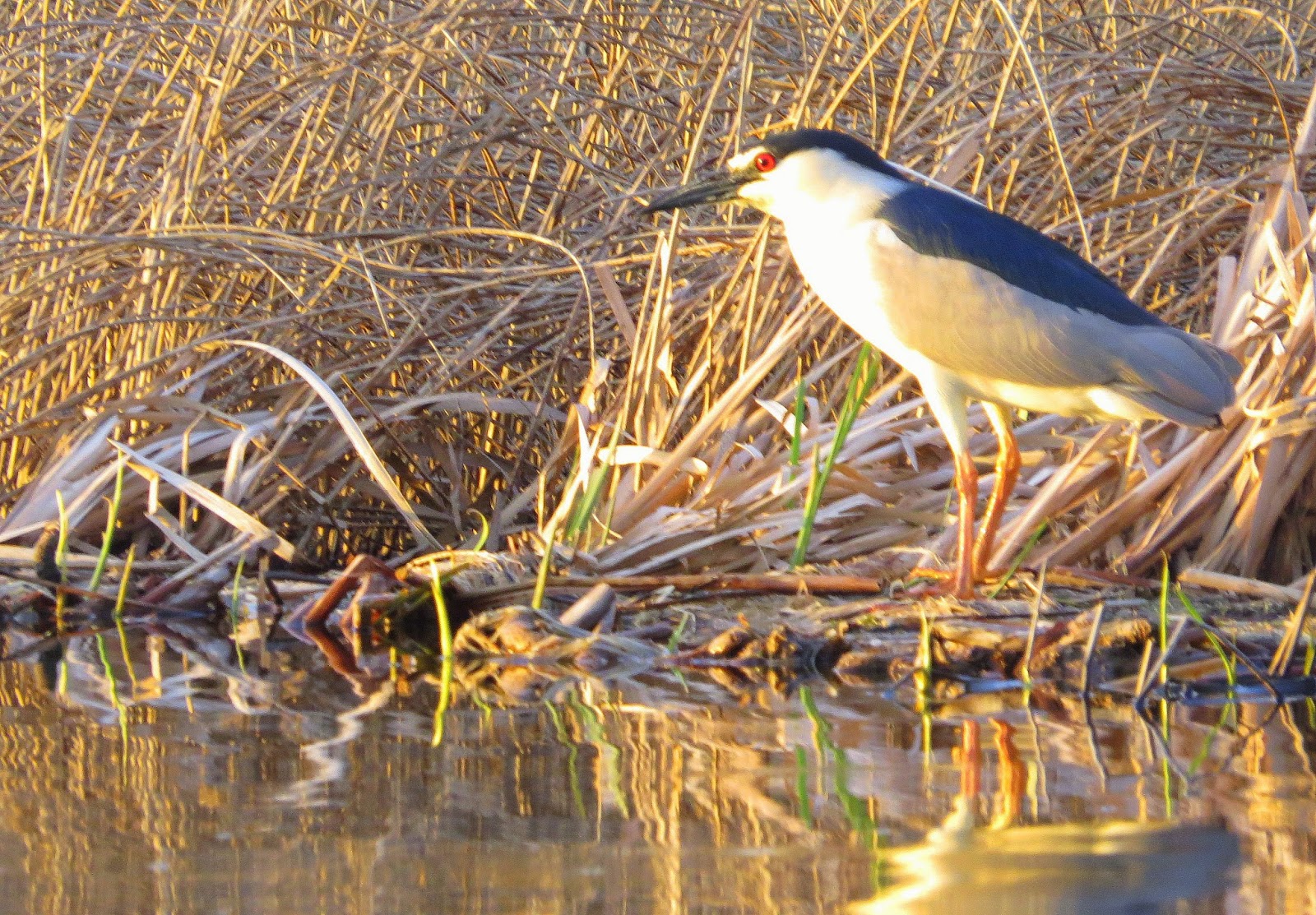
The signature bird of Cherry Lake is the black-crowned night heron. These birds of dawn and twilight nest in the marshes between the local lakes and along the creek.

Their red eyes apparently help them to see in dimmer light.

I see American wigeons off and on through the summer near and on Cherry Lake.

By June, nests were being made . . . (this one is a Wilson's Phalarope nest) . . .


And here is a Sharp-tailed Grouse hen, brooding her new hatchlings in a pea field near the road where I do my Breeding Bird Survey at Tyvan. When she lifted her skirts, a dozen caramel and ochre-coloured feather balls jumped up and skittered off into the vegetation.

In June, during a bird blitz on and around Cherry Lake, one group found a pair of Trumpeter Swans, very rare for the prairie region. A couple of weeks later, I got image of them far across a large slough with five new cygnets.


While kayaking the rapids on Swift Current Creek on Canada Day, I took this distant shot of a Yellow-breasted Chat in full song. There were seven of them along that stretch of creek.


These white pelicans roost on the spit that cuts across Deep Lake just north of Cherry Lake.


And, finally, we came across this male snowy owl on the Regina Christmas Bird Count on December 27.


Thursday, December 11, 2014

Sage Grouse: the View from the Saddle--Part II

all photos courtesy of Miles Anderson


Last month, I bumped into Fir Mountain rancher Miles Anderson at The Exchange in Regina, where his daughter Kacy was on stage performing with Clayton Linthicum. When you have a chance to visit with one of Saskatchewan’s most respected rancher/stewards of native grass--the fellow who has more Greater Sage-Grouse on his land than anyone else in Canada--you don’t pass it up.

Some of what I learned from Miles that night I wrote up in a previous post, The View from the Saddle, Part I, but before we parted ways he mentioned he was heading to a conference.

“I’m off to Salt Lake City next week to talk at a conference sponsored by the Sage Grouse Initiative.” He agreed to let me call him afterwards, to get his impressions of the conference, and talk a bit more about sage grouse and prairie conservation.

This week we finally caught up with one another on the phone and had a good long talk about ranching, stewardship, and the sorry state of sage grouse at the northern edge of their range.

“It might seem like we have a lot of sage grouse habitat here and in the park (Grasslands National Park),” Miles said, “but if you look at their whole range on the continent, we are just a postage stamp. One of the things that makes this land different is that it wasn’t glaciated. So it starts right in the soil, and its part of why we have so many rare species. It’s not something I am doing. It’s just the way this place is.”

Miles and his wife Sheri run cattle on 30,000 acres, including 22 sections of native grass right along the international boundary--all of it excellent habitat for Greater Sage-Grouse and many other species at risk. The sage grouse use a variety of landscapes on his range: wet places such as alkali flats, as well as uplands and lowlands. “In winter, they need places where they can feed on sage brush, which means it has to be high enough to poke out of the snow. If the snow’s too deep, they move south to find sage brush they can get at.

“My neighbour to the south in Montana was at the conference as well. His land runs from the border almost all the way down the Milk River. He was a guest speaker too and we both had some good air play.”

Miles said that most presenters and participants at the conference were from the science and conservation sectors, but there was some representation from industry (mining and oil and gas).

One of his favourite moments at the conference was when Noreen Walsh, Regional Director with U.S. Fish & Wildlife was speaking. “She said something that agrees with what I see on our land: ‘what’s good for the birds is good for the herds.’”

“Sure, it’s just anecdotal, but I saw some things this past summer that prove the point. It might sound funny but I know what I saw.”

The strangest thing he learned this summer was that sage grouse seem to like hanging around his cattle. The Anderson land adjoins part of the East Block of Grasslands National Park. That side of the park had not been grazed by any kind of bovine in 25 years. This summer, though, the Park welcomed Miles and his Angus cattle onto a portion of the East Block. 

The hard part was getting them to stay there once they opened the fence. 

“The grass is old and ugly, so we were always having to chase them back into the park.” That meant Miles was on horseback and moving cattle during a time of the summer when he does not usually ride among his herd.

“We saw sage grouse every day, but we always saw them with the cattle.” In his experience, the hens leave the sage brush bottom lands soon after the young hatch, but later in the summer they return with half-grown chicks. 

one of Miles' photos showing sage grouse near his cattle


“They might be showing them how to feed on sage--I don’t know--and maybe they like the cattle because it helps them find bugs.”

Though Miles was excited to see good numbers of sage grouse with young this summer and well into the fall, he knows the next trick is to get good survival into the next year.

Survival is influenced by many factors, but, like many who live in sage grouse country, he is concerned about predators. “We’ve got ravens like you wouldn’t believe. Then the coyotes, hawks, and swift foxes are probably taking their share. And that might be another reason the grouse like cattle around. I’ve watched them take refuge close to cattle when a harrier flies overhead. You have to ask yourself if there is something we’re doing that gives predators an advantage now. Coyotes especially--back in the days when people could control coyotes we used to see hundreds of sage grouse.”

But a rancher like Miles Anderson knows there are no simple answers. He thrives by respecting the complex interrelationships between weather, grass, the genetics of his herd, and his own management practices. “One of the speakers at the SGI conference said ‘there is no single cause of sage grouse decline. There isn’t going to be any single solution.’ That seemed right to me.”

Toward the end of our call, I asked Miles what he would do if he had a couple million dollars to help out the Greater Sage-Grouse in his corner of Canada’s grassland.

“That’s a tough one, but I guess I would spend it on connecting the science people with ranchers. I think the Sage Grouse Initiative has done some good things in the States. There are a dozen or more programs that a producer might qualify for down there, but they send out a rep and if you’re interested they’ll assess your operation and then figure out which programs might work for you. Might be something to do with fencing or infrastructure, might be about water development, deferred grazing, grass banking. All kinds of things. Then they do all the paper work for you. It’s all completely confidential so the ranchers feel safe and they don’t have to do all the applying and figuring. The resource person comes back with a program or two and gets it going. I think they get pretty good uptake that way.”

Miles added that, while ranchers are naturally cautious and some have had bad experiences in the past with conservation programs, he agrees that building trust and rapport between producers and the conservation and government sectors must be a priority.

“Take the pipit (Sprague’s pipit, another species at risk on his grasslands). You look across the fence and see, well this guy has a lot more pipits than his neighbour. Why not get to know him, spend some time there and learn what he is doing that makes the difference? Then you’ve got to find a way to encourage more of that, to make it worth other ranchers’ time to try something new.”

You don’t last in the ranching life as long as Miles has by jumping to conclusions or adopting every new management trend that comes along. Applying the same caution to sage grouse, he is not going to make any rash predictions about its future or claim to know exactly what needs to be done.

And yet, after listening to him discuss the prairie and its declining birds, you go away believing that there might be some hope left. With people like Miles Anderson on the land, and some resources and political will to work with ranchers and industry, is it possible that we could find the mix of private and public management, science-based and traditional stewardship to bring the Greater Sage-Grouse back into its long vacant breeding grounds on the Canadian Plains?

To even take a shot, though, Alberta and Saskatchewan are going to need some government (federal and provincial) commitment to create programming that is a lot closer to what the Sage Grouse Initiative has going south of the border. Take a look at the SGI web site--you will see right away that Canada has nothing to compare with this program.

If you look very closely, there is a grouse in the centre-right of this photo just taking flight

Monday, December 1, 2014

"The Last Cowboy," a mini-doc about the PFRA's Jim Commodore of Val Marie


I have written a couple of stories in this space about the cowboys who are the lifeblood of the PFRA community pastures. Men like Mert Taylor and Eric Weisbeck are among the last of the public servants who saddle up a horse to manage Canada's federal grasslands now being transferred back to Saskatchewan and Manitoba.

They are at the tail end of a lineage of PFRA cowboys running back three-quarters of a century. A couple of days ago a friend sent me a link to a new documentary that pays tribute to one cowboy whose life runs almost all the way back to the origins of the PF system.

Jim Commodore was born in 1941 at the Val Marie PFRA pasture, just west and a bit north of Grasslands National Park. The Val Marie pasture is the largest in the system at more than 90,000 acres and it is an ecological and cultural treasure that should remain in the public trust and be granted the kind of protection Canada's rarest landscapes all deserve.

Jim Commodore, retired PFRA cowboy at Val Marie


Megan Lacelle and Kaitlyn Van De Woestyne, two young women studying Journalism at the University of Regina, made the six minute documentary to fulfill a class assignment. They call it "The Last Cowboy" and it is for my dollar the best piece of work showing some of the human costs of abandoning the PFRA system. I hope it is seen far and wide and that its message, told entirely in the humility of an honest cowboy recalling his days on the land, will pluck a few heart strings and remind prairie people why we must retain and honour the legacy of the community pastures system.

Kaitlyn and Megan graciously agreed to allow me to post The Last Cowboy (see below), and sent me some of their reflections on the project. I am including Megan's comments below as an introduction to the film. As fate would have it, Megan and Kaitlyn shot the documentary on Remembrance Day weekend. Here's hoping that the professional media world will welcome the kind of sensitivity and light hand that Megan and Kaitlyn are already applying as students.

"I grew up in Cadillac, Sask. (about 30 minutes north of Val Marie). My mom grew up in Val Marie and my grandparents still ranch there. My mom worked on the PFRA when she was younger (before me) and as I was growing up I heard lots about them from my parents and grandparents. I started working for my dad at his gas station when I was 13 and that's when I started to meet the men and women who worked for the PFRA. Among them was Jim Commodore. I always found him so humble, interesting and well-spoken that I knew when I got into Journalism school that I would love to tell his story. When I heard about the decisions to shut the PFRA's in 2012 I knew I wanted to shine a spotlight on the people and culture surrounding them. This year we were able to do a mini-doc assignment on anything we chose - I asked Kaitlyn about doing it on this and she agreed!
So we phoned Jim up and asked if he'd be okay with it. Jim, always the gentleman, said he would do whatever it took to help us out. So we road tripped down to Val Marie on Remembrance Day weekend this year and we filmed him and our B-roll all in one day.
I love the area, the people and the culture in the southwest rural corner of the province - I got into journalism to shed a spotlight on incredible "everyday" people and this gave us a great opportunity to tell Jim's story as well as tie into a greater story about the loss of the PFRA's and what that means to the area, people and culture.

Oftentimes people get caught up in statistics and big figures and forget to talk to people who know the topic best - I knew Jim would be a great resource and a way to make a historical document. His father worked PF's before him and so he'd always known what they meant to the area. He's an amazing person. He, like my grandparents, I believe are the last of a breed of cowgirls and cowboys who understood the importance of people, community and the environment."

The Last Cowboy from Megan Lacelle on Vimeo.


Share this post

Get widget